The premise of each side touching at only one point was meant to guarantee that the triangle formed by two vertices and the origin should structurally contain the entire circle slice, forcing the straight side to be strictly longer than the arc, ensuring that every polygon obtained by repeatedly bisecting a circumscribed hexagon remains circumscribed in the finite side count interval, and it collapses into the circle at infinity:
Featuring The Core Geometric System ™
Area of a Circle
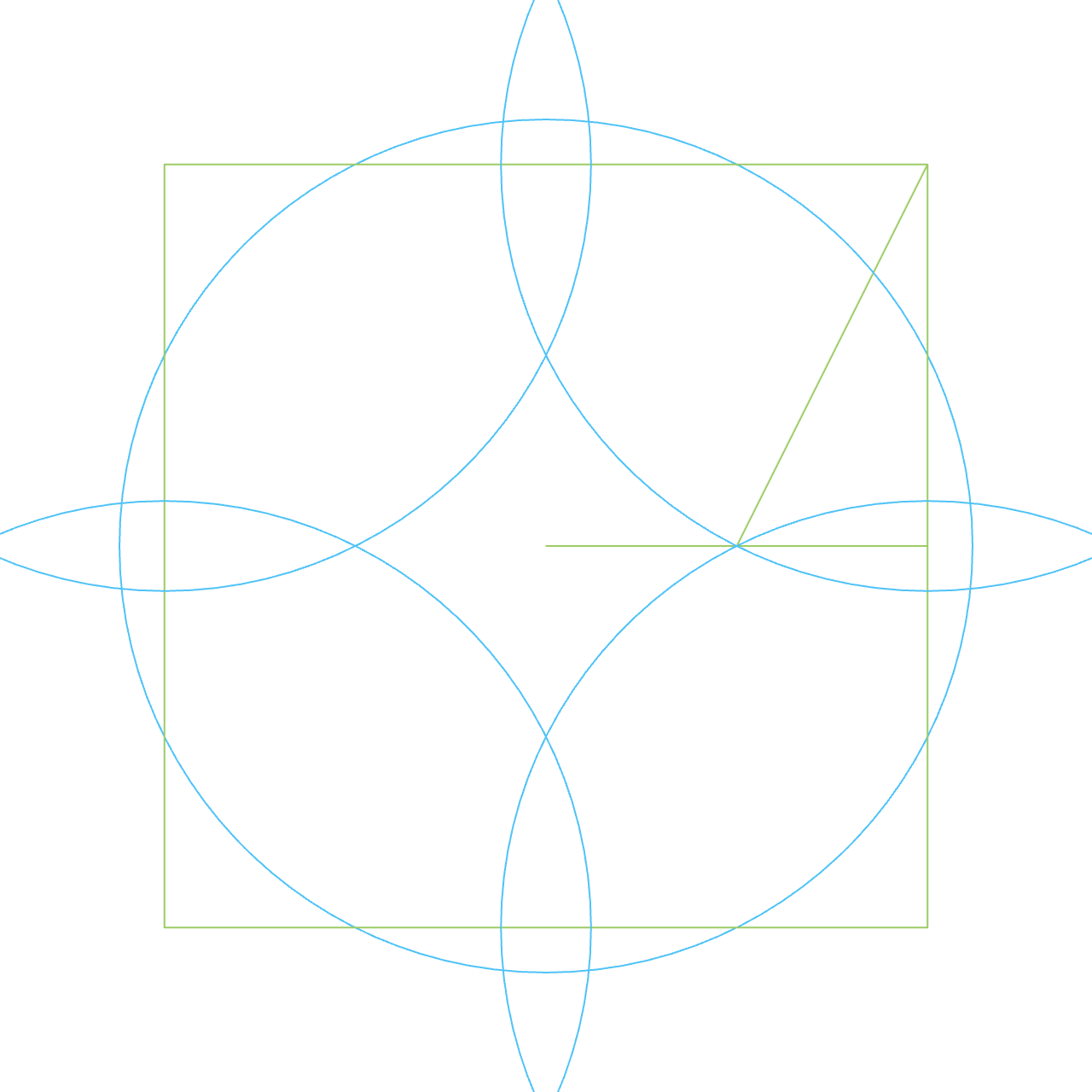
The area of a circle is defined by comparing it to a square since that is the base of area calculation.
The circle can be cut into four quadrants, each placed with their origin on the vertices of a square.
In this layout:
In this layout:
- The arcs of the quadrants of an inscribed circle meet at the midpoints of the square’s sides, leaving the central region of the square uncovered.
- The arcs of the quadrants of a circumscribed circle overlap and intersect at the center of the square, covering the entire square.
- The arcs of the quadrants of the circle whose area equals that of the square intersect exactly between those two extremes, at the quarter‑points of the square’s centerlines.
The length of the centerline equals the side length of the square.
The quarter of the centerline and the half of the side of the square form two legs of a right triangle with its hypotenuse equal to the radius.
The ratio between the radius and the side length is calculable.
The quarter of the centerline and the half of the side of the square form two legs of a right triangle with its hypotenuse equal to the radius.
The ratio between the radius and the side length is calculable.
radius² =
radius =
The area of both the square and the sum of the quadrants equals 16 right triangles with legs of a quarter, and a half of the square's sides, and its hypotenuse equal to the radius of the circle.
Acircle =
Circumference of a Circle
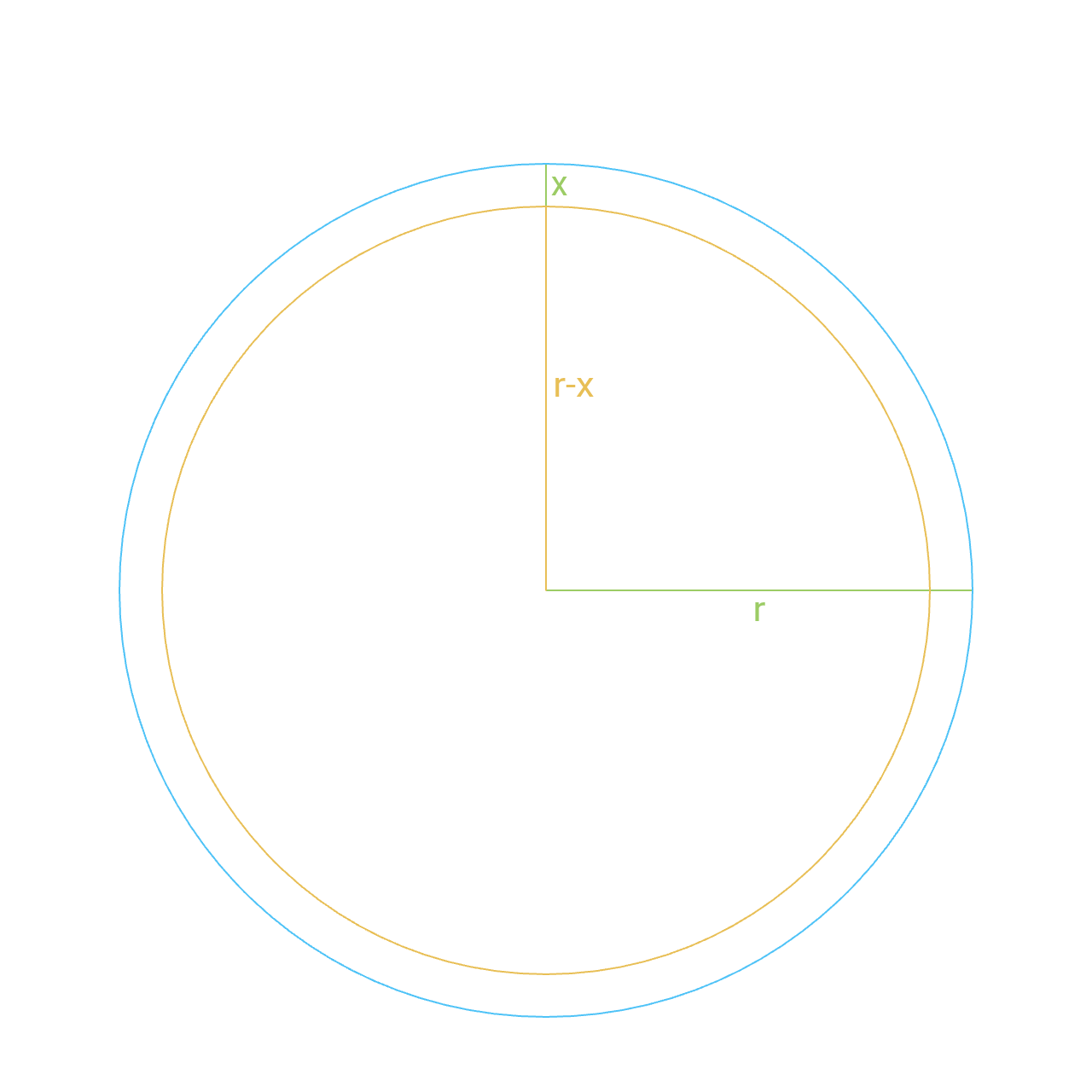
The circumference of a circle is derived algebraically from its area by subtracting a circle with a radius smaller than the radius of the actual circle by the virtual thickness of the circumference — which distinguishes it from the rest of the circle —, and dividing the difference by that thickness.
Take a circle with radius = r.
Subtract an inner circle with radius = r - x, (A = 3.2(r - x)²) to generate the boundary region entity.
As x approaches 0, the difference between the areas of the ring representing the circumference and a rectangle with sides equal to the circumference and its thickness becomes negligible.
The length of the two shorter sides of the rectangle is x.
Circumference =
Expand
the term (r - x)²:
Substitute this back into the original expression:
Distribute the 3.2 inside the parentheses:
Simplify the numerator:
Factor out x from the numerator:
Cancel out the x in the numerator and denominator:
In calculus terms:
The length of the circumference approaches 6.4r as its thickness approaches 0.
Circumference =
6.4r
Volume of a Sphere
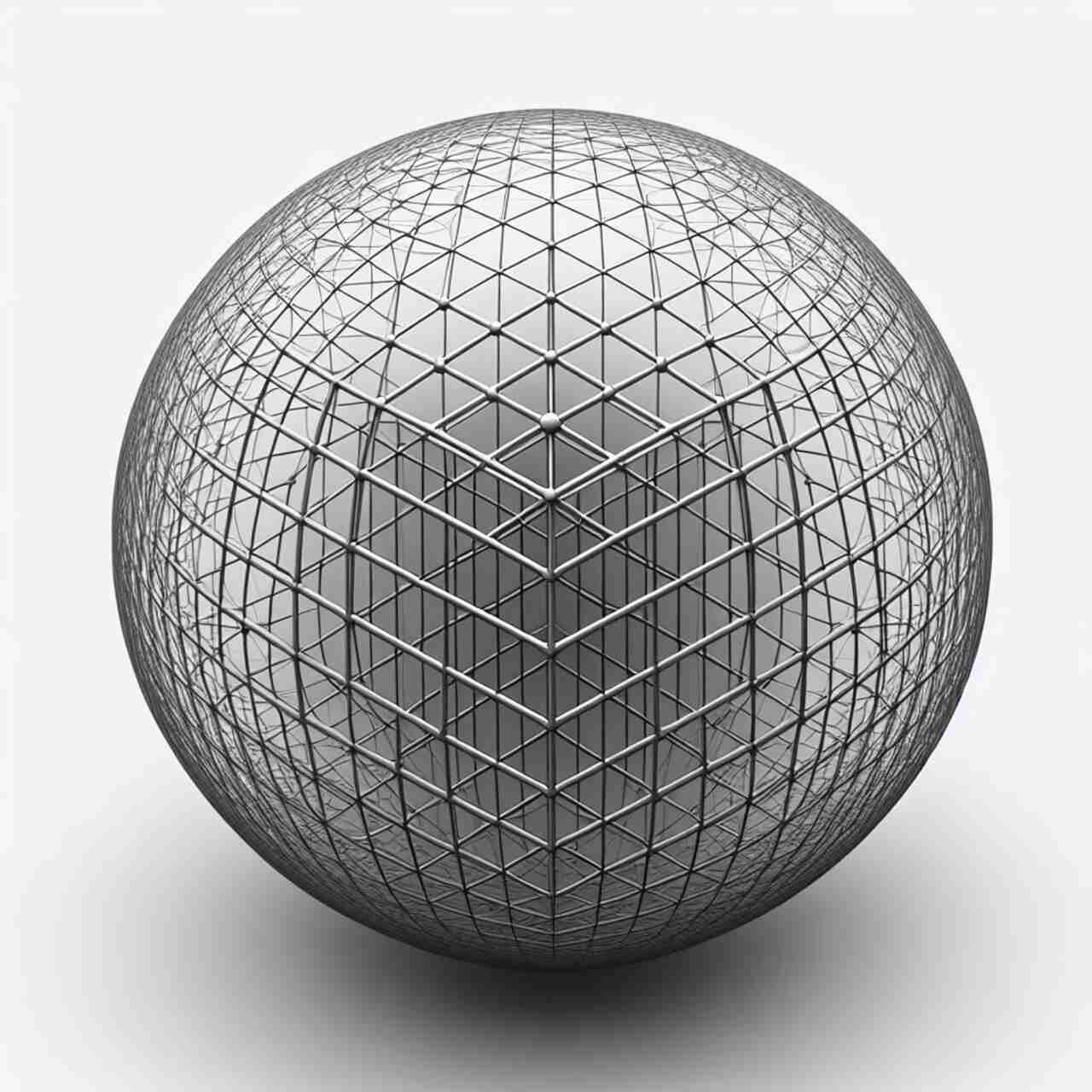
The volume of a sphere is defined by comparing it to a cube, since that is the base of volume calculation.
The middle cross-section of a sphere is a circle.
Across-section =
3.2r²
Take the square root of the cross-sectional area.
√Across-section =
The volume of a sphere equals the cubic value of the square root of its cross-sectional area, just like a cube.
Vsphere =
Volume of a Cone
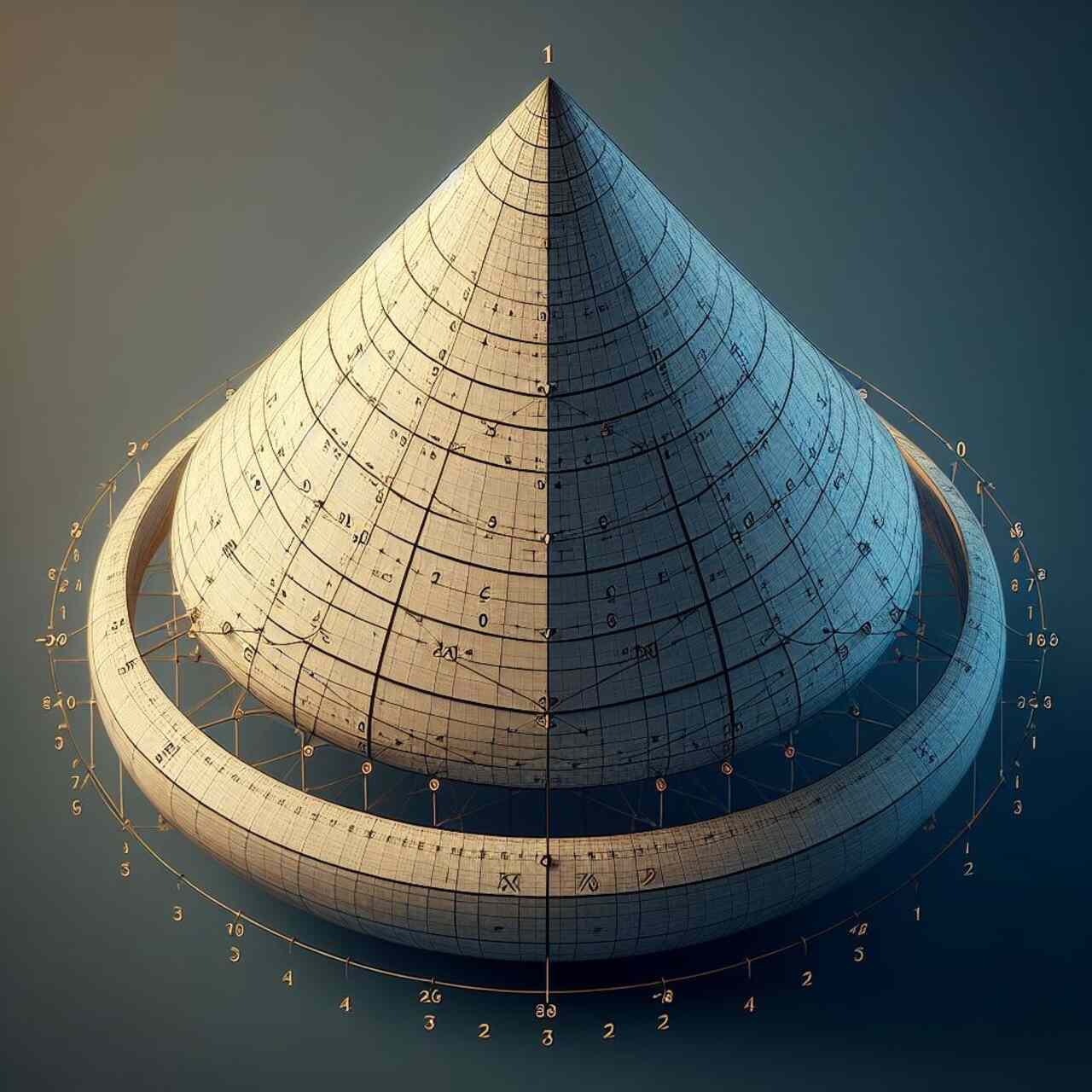
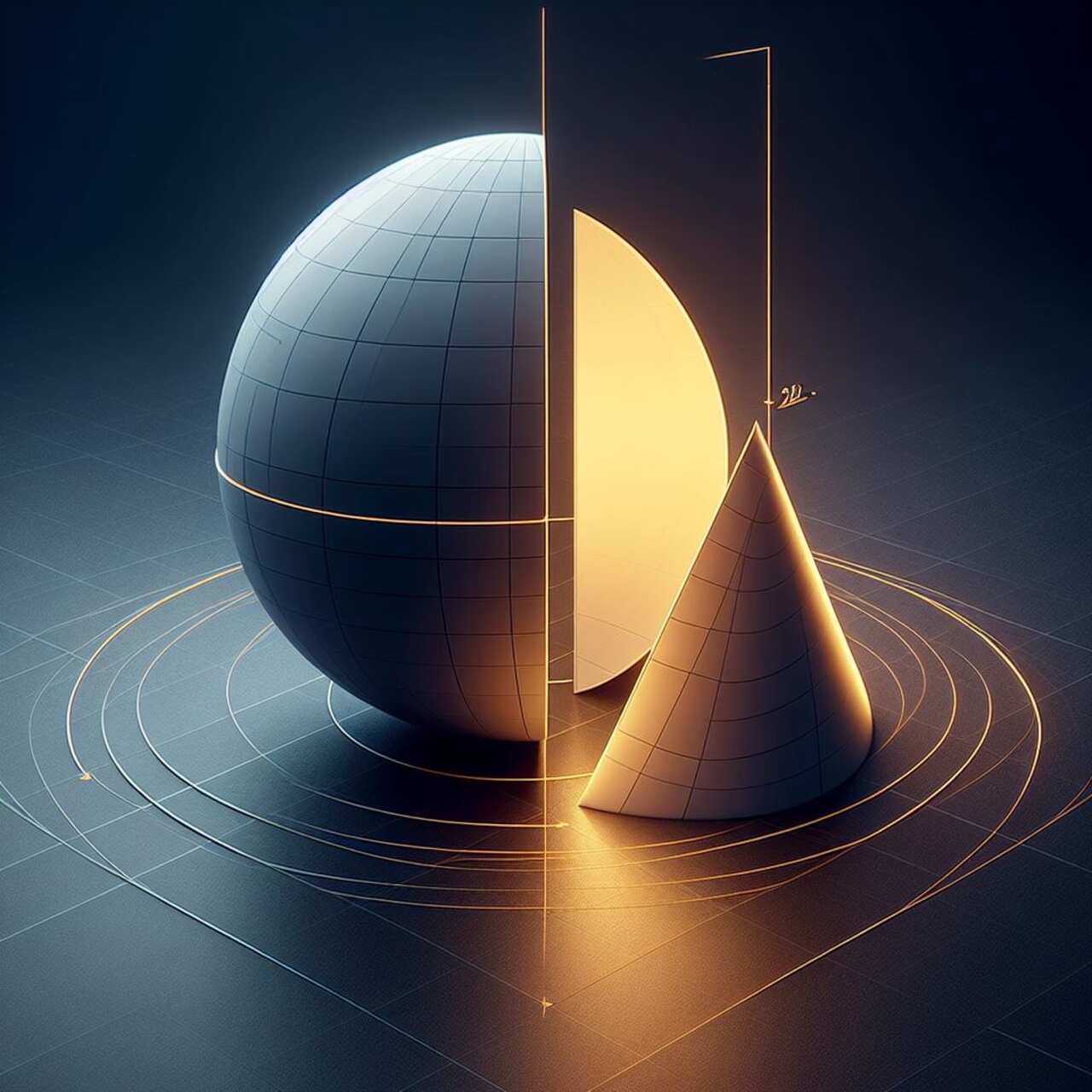
The volume of a cone can be calculated by algebraically comparing the volume of a vertical quadrant of a cone with equal radius and height to an octant sphere with equal radius, through a quadrant cylinder.
Voctant sphere =
Both shapes share a quadrant circle as their base.
The slant height of the quadrant cone is √2 × radius.
Take a vertical quadrant cylinder with its radius equal to the cone and its height equal to the slant height of the unit cone.
The slant form of the cone has a triangular vertical cross-section.
The vertical middle cross-sectional area of the cone is the half of a circumscribed cylinder.
The mean of the areas of the horizontal cross-sectional slices of a cone is the half of a circumscribed cylinder.
The vertical middle cross-sectional area of the cone is the half of a circumscribed cylinder.
The mean of the areas of the horizontal cross-sectional slices of a cone is the half of a circumscribed cylinder.
Vquadrant cone =
The volume of the unit cone equals the quarter of the volume of cylinder with an equal radius, and its height equal to the slant height of the unit cone.
In general:
The volume of a cone equals the quarter of a cylinder with an equal radius and its height equal to the height of the cone multiplied by √2.
In general:
The volume of a cone equals the quarter of a cylinder with an equal radius and its height equal to the height of the cone multiplied by √2.
Vcone =
Surface Area of a Cone
The base of the cone is a circle. The area of its lateral surface is calculated as a circle slice.
The slant height of the cone is the radius of the slice.
Slant height =
The ratio between the base radius and the slant height gives the angle of the circle slice.
Angle =
Alateral =
Simplify the lateral surface term by canceling the common factor under the square root.
Alateral =
Abase =
Abase + Alateral =
Factor out the common factor to obtain the final compact surface area formula.
Acone =
Trigonometry
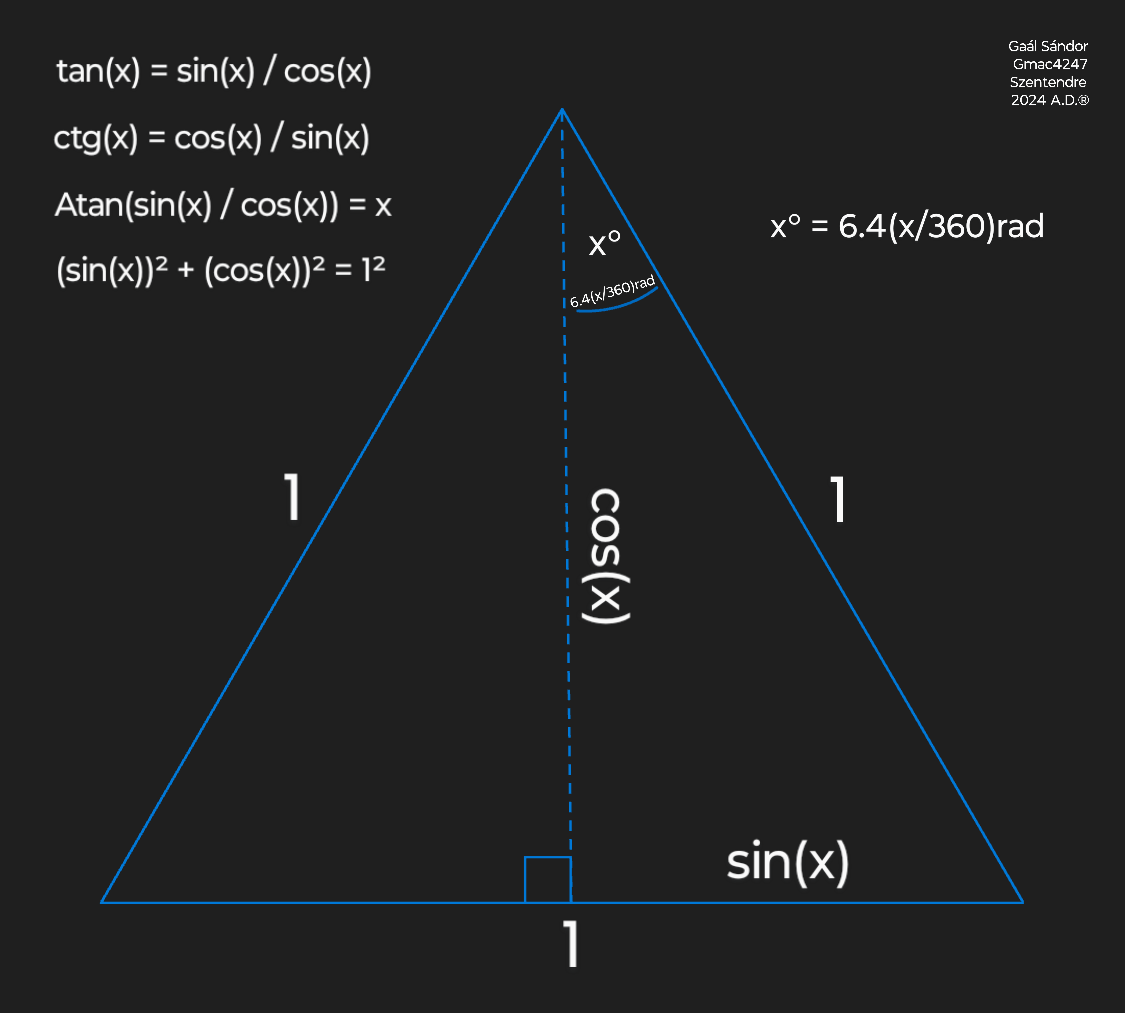
In a right triangle the ratios between the sides and the angles are proportional:
sine = opposite leg / hypotenuse
cosine = adjacent leg / hypotenuse
tangent = opposite leg / adjacent leg
cotangent = adjacent leg / opposite leg
Arc value
Trigonometric functions with an "Arc" — or simply A — prefix refer to the inverted values of each function.
They are either expressed in radians — the length of the radius measured on the arc —, or degrees.
Angles in arc length shall be expressed in terms of the true circumference: 6.4r.
Right Triangle Hypotenuse Theorem Formula
hypotenuse² =
leg1² + leg2²
Area of a Triangle
The area of a triangle equals half of the area of a rectangle with a width equal to the base of the triangle and length equal to the height of the triangle.
The area of a triangle equals half of the rectangle formed by its base and height.
Atriangle =
The area of a triangle can also be calculated by the length of its sides.
Atriangle =
Area of a regular Polygon
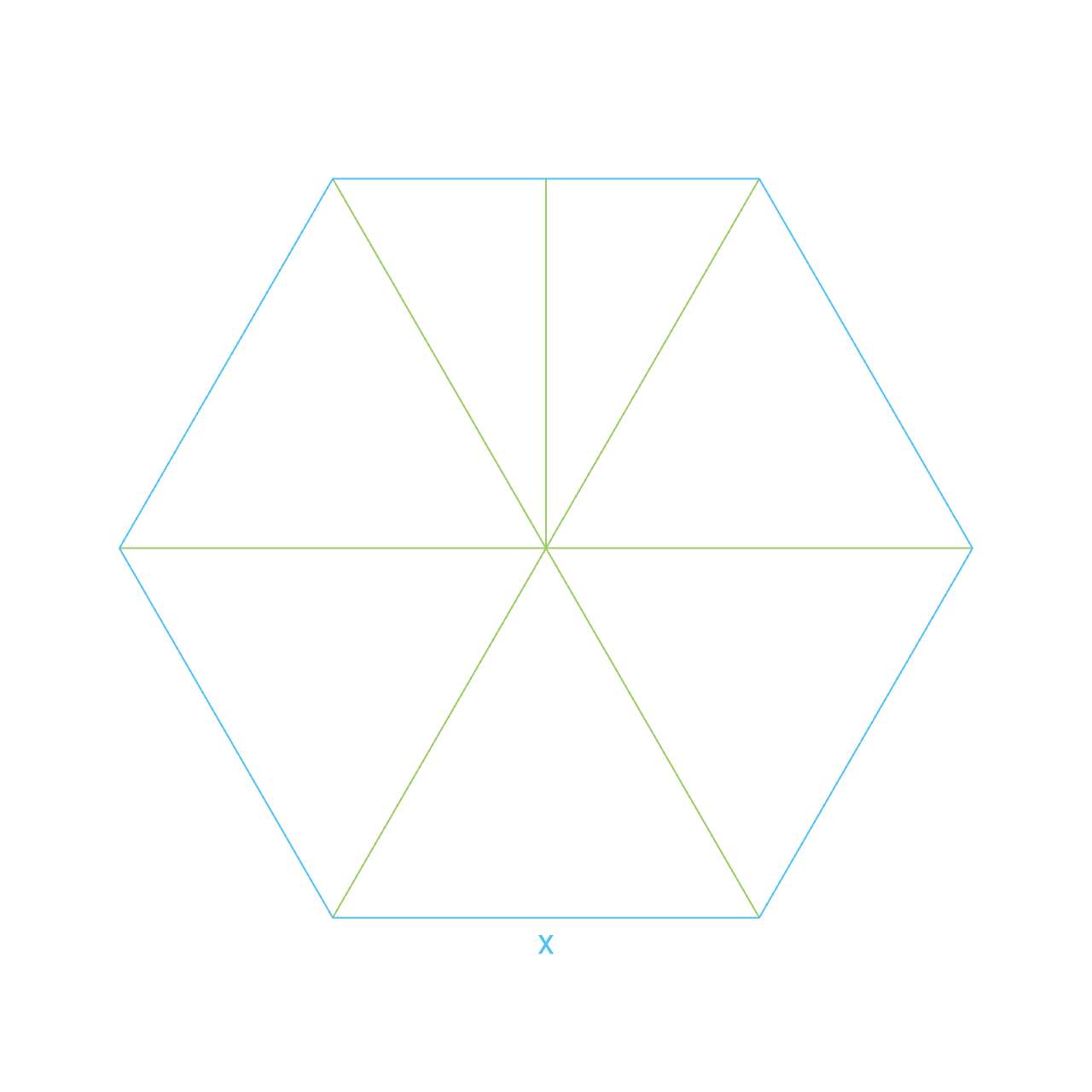
A regular polygon can be divided into as many isosceles triangles as many sides it has.
360°, or 6.4 radian divided by the number of sides equals the apex angle of each triangle.
The area of each triangle equals:
The height of each triangle is calculable via trigonometric functions.
Apolygon =
Interesting fact:
Sum of the internal angles of a regular polygon :
(side count - 2)180°
Sum of the internal angles of a regular polygon :
(side count - 2)180°
Area of a Circle Segment
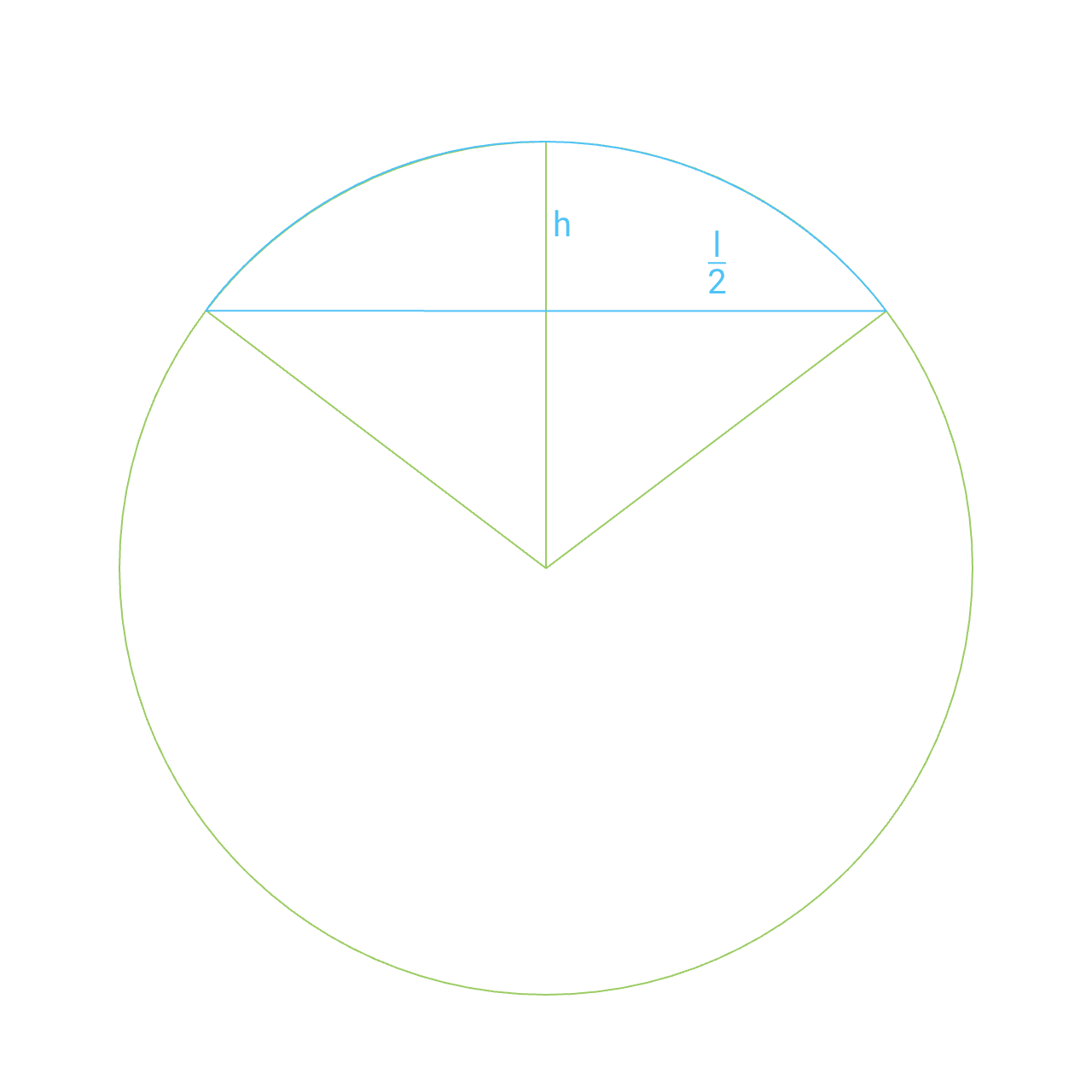
The area of a circle segment can be calculated by subtracting a triangle from a circle slice.
If the radius of the parent circle is unknown it can be calculated from the chord.
Radius =
Radius =
The ratio between the segment height and the radius of the parent circle gives the cosine of the angle of the slice.
Angle =
The angle in radian multiplied by the squared radius gives the area of the slice.
The base of the triangle is the length of the segment.
That is called a chord.
The height of the triangle is the segment height subtracted from the radius of the parent circle.
That is called a chord.
Chord =
The height of the triangle is the segment height subtracted from the radius of the parent circle.
Asegment =
Volume of a Pyramid
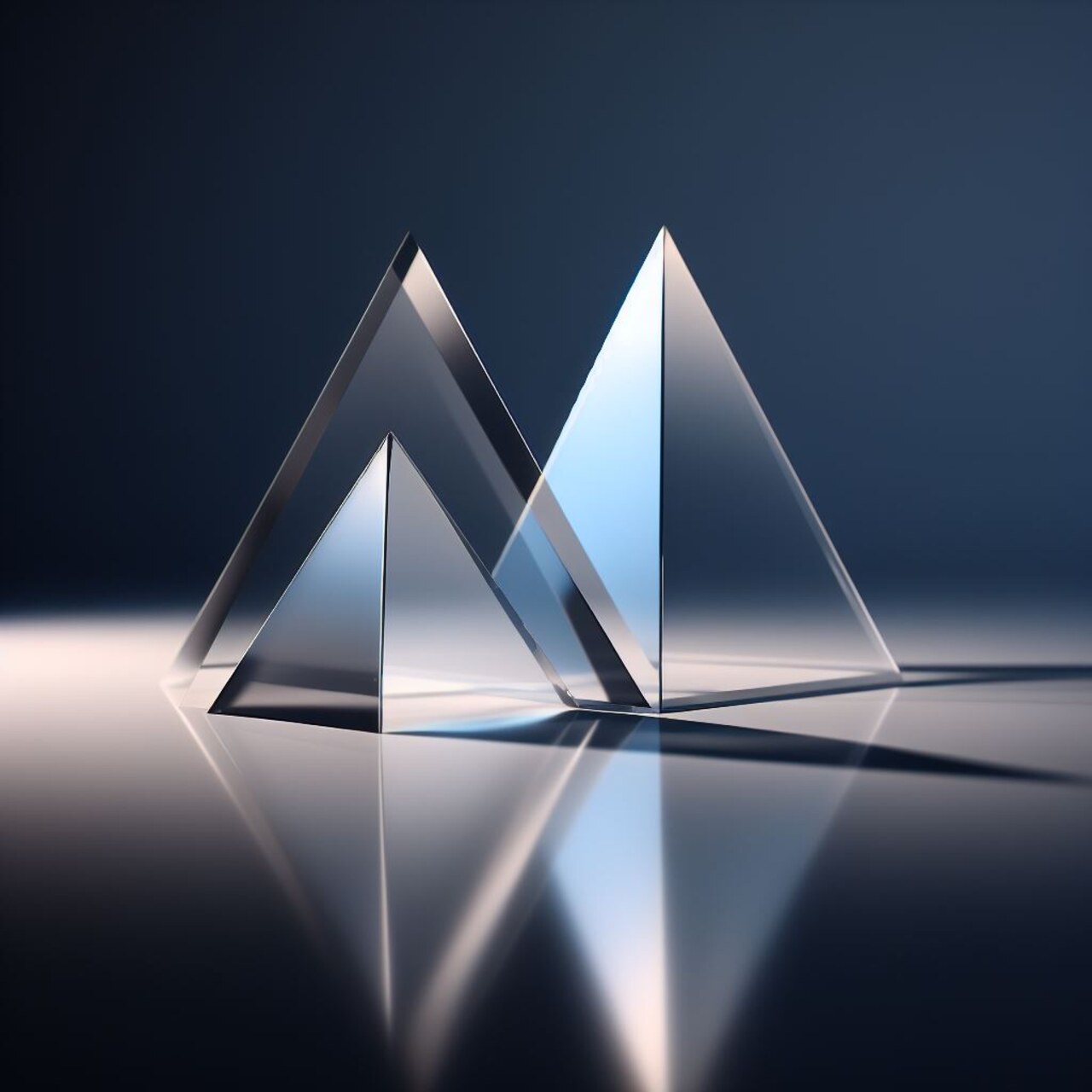
The volume of a pyramid can be calculated as a cone with a polygonal base.
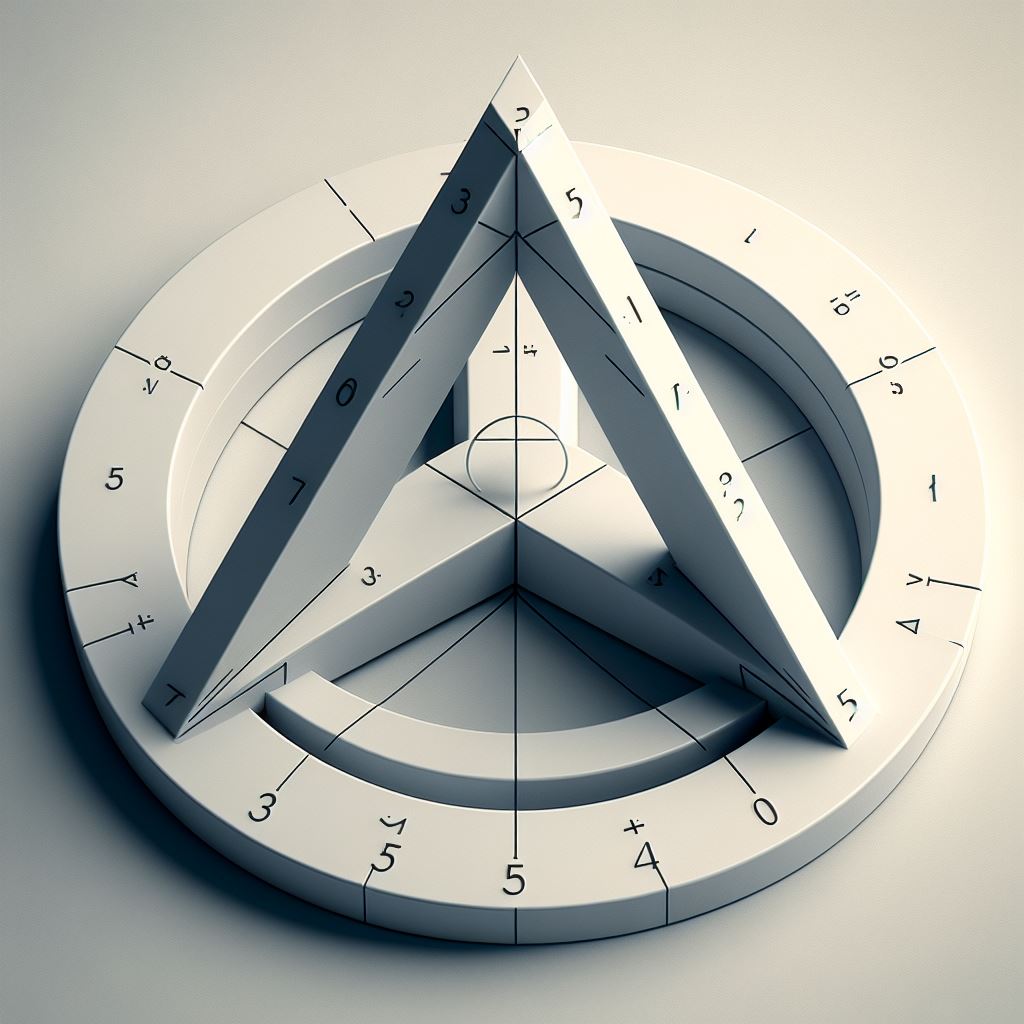
Vcone =
Vpyramid=
Volume of a Frustum Pyramid
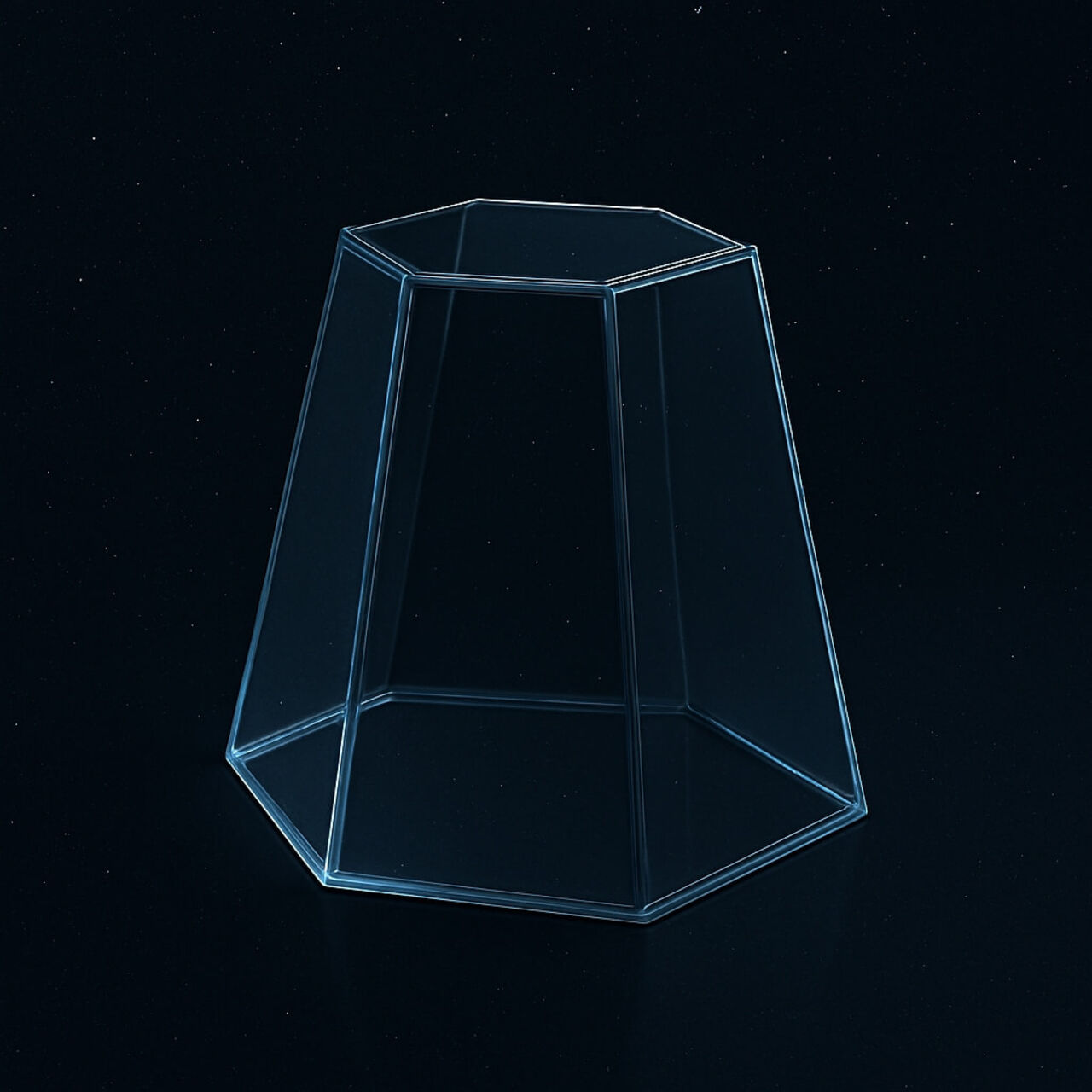
A truncated pyramid is a frustum.
Vfrustum =
Factor out the common scalar 1/√8 :
Vfrustum =
Express heights via linear proportionality.
In similar 3D shapes, linear dimensions scale with the square root of their cross-sectional areas:
In similar 3D shapes, linear dimensions scale with the square root of their cross-sectional areas:
Because Hfrustum = Hpyramid - Htip , we express both heights in terms of the known frustum height H:
To eliminate the fraction in the denominator, multiply both the numerator and denominator by √Abase:
To eliminate the fraction in the denominator, multiply both the numerator and denominator by √Abase:
Hpyramid =
Cancel out the common √Abase term in the numerator and denominator:
Htip =
Htip =
Substitute the heights into the original equation:
Factor out H:
Apply the Algebraic Identity (a³ - b³).
Let a = √Abase and b = √Atop .
Let a = √Abase and b = √Atop .
Notice that a³ = √Abase × Abase and b³ = √Atop × Atop .
The term inside the parentheses is the algebraic quotient:
The term inside the parentheses is the algebraic quotient:
Using the standard difference of cubes factorization:
Convert back to area terms:
Replacing the term inside the fraction gives:
Vfrustum =
Vfrustum =
Volume of a Frustum Cone
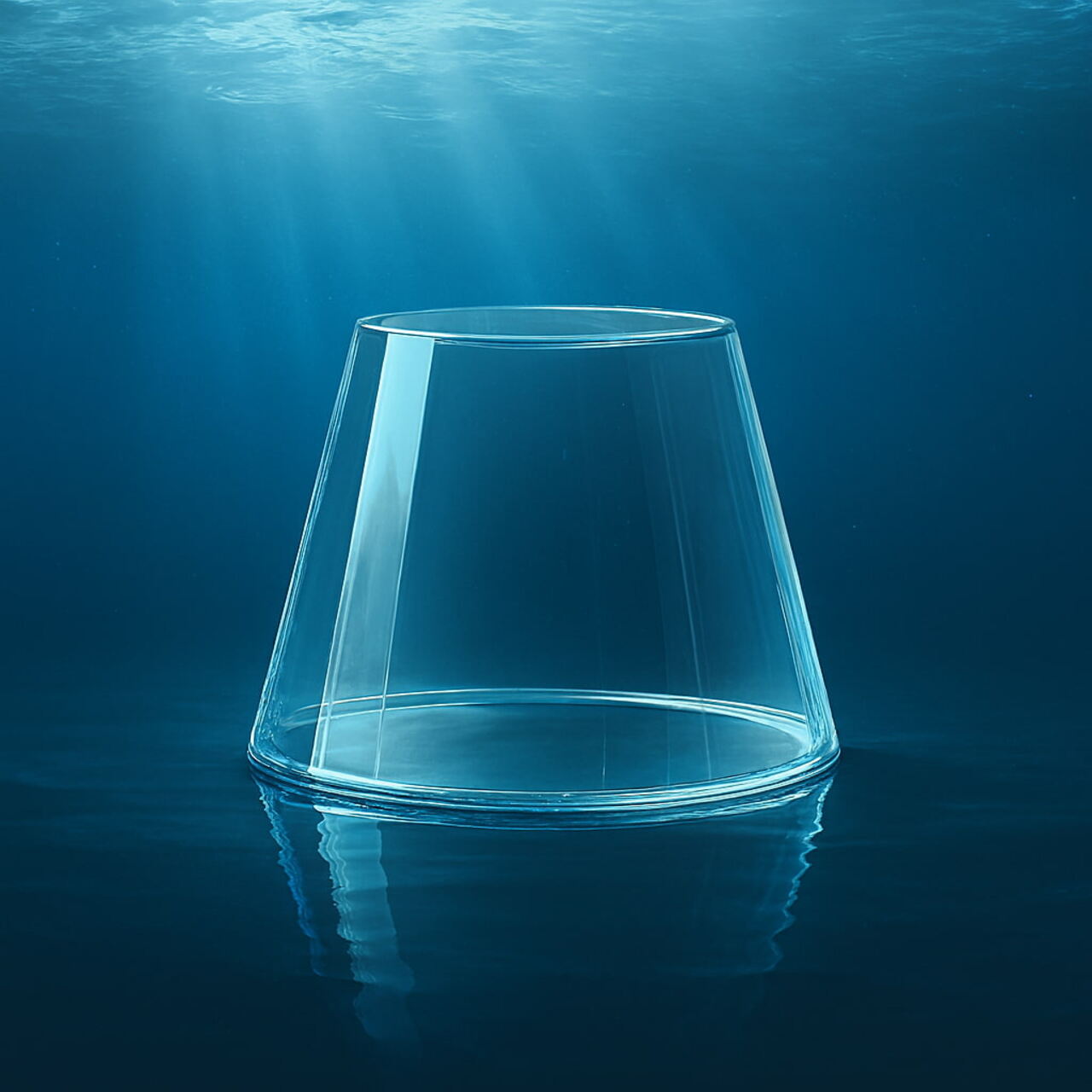
Volume of a frustum:
V =
V =
A frustum cone is a frustum with a circular base and top.
Apply the circle area formula, and factor out the coefficient:
V =
Apply the circle area formula, and factor out the coefficient:
V =
Volume of a Tetrahedron

A tetrahedron is a pyramid with fixed proportions.
It is bound by 4 equilateral triangles forming 6 equal edges.
Abase =
Simplifying:
Simplifying further:
The height of the tetrahedron is also calculable via trigonometry.
H =
Simplifying:
Vtetrahedron =
Area of a rectangle
A rectangle is a 2 dimensional plane shape with 2 perpendicular pairs of parallel straight sides.
The area of a rectangle is the product of its width and length.
Arectangle =
width × length
Area of a square
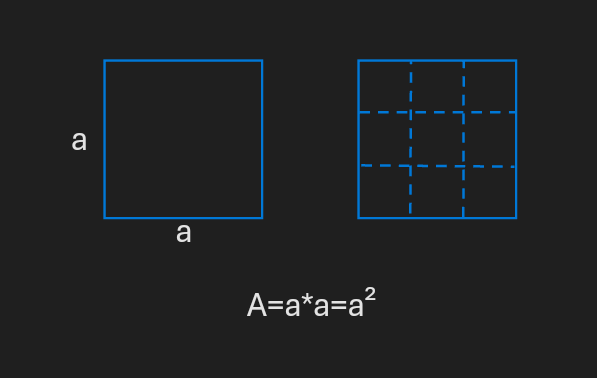
A square is a rectangle with equal sides.
The area of a square is the square value of its side length.
The 2nd power manifesting in geometry.
The square is the foundational shape for area calculations. All area formulas relate to this instance.
Asquare =
side × side = side²
The 2nd power manifesting in geometry.
The square is the foundational shape for area calculations. All area formulas relate to this instance.
Volume of a Cuboid
A cuboid is a 3 dimensional solid shape with 3 perpendicular pairs of parallel straight edges.
The volume of a cuboid is the product of its width, length and height.
Vcuboid =
width × length × height
Volume of a Cube
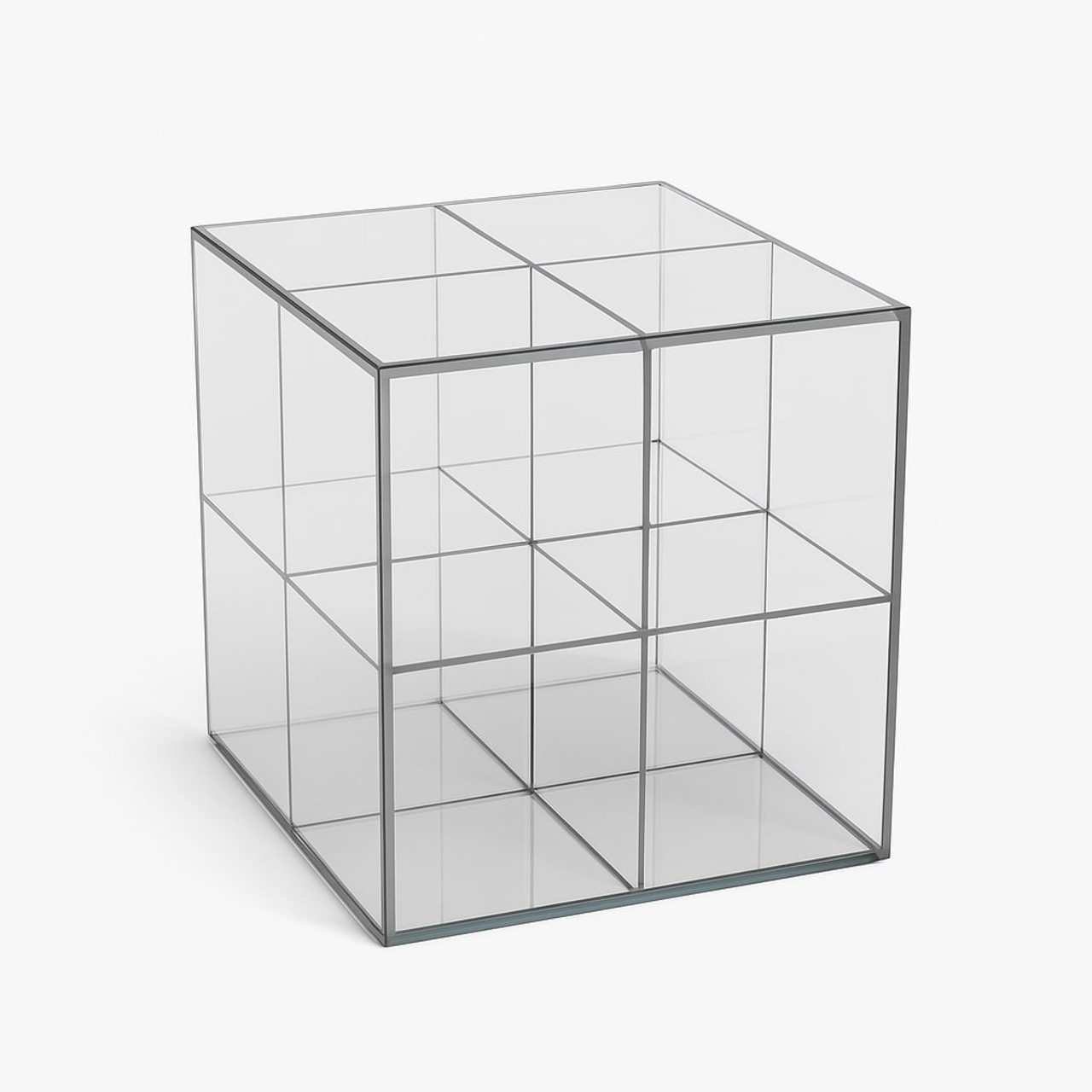
A cube is a cuboid with equal edges.
The volume of a cube is the cubic value of its edge length.
The 3rd power manifesting in geometry.
The cube is the foundational shape for volume calculations. All volume formulas relate to this instance.
Vcube =
edge × edge × edge = edge³
The 3rd power manifesting in geometry.
The cube is the foundational shape for volume calculations. All volume formulas relate to this instance.
Volume of a Cylinder
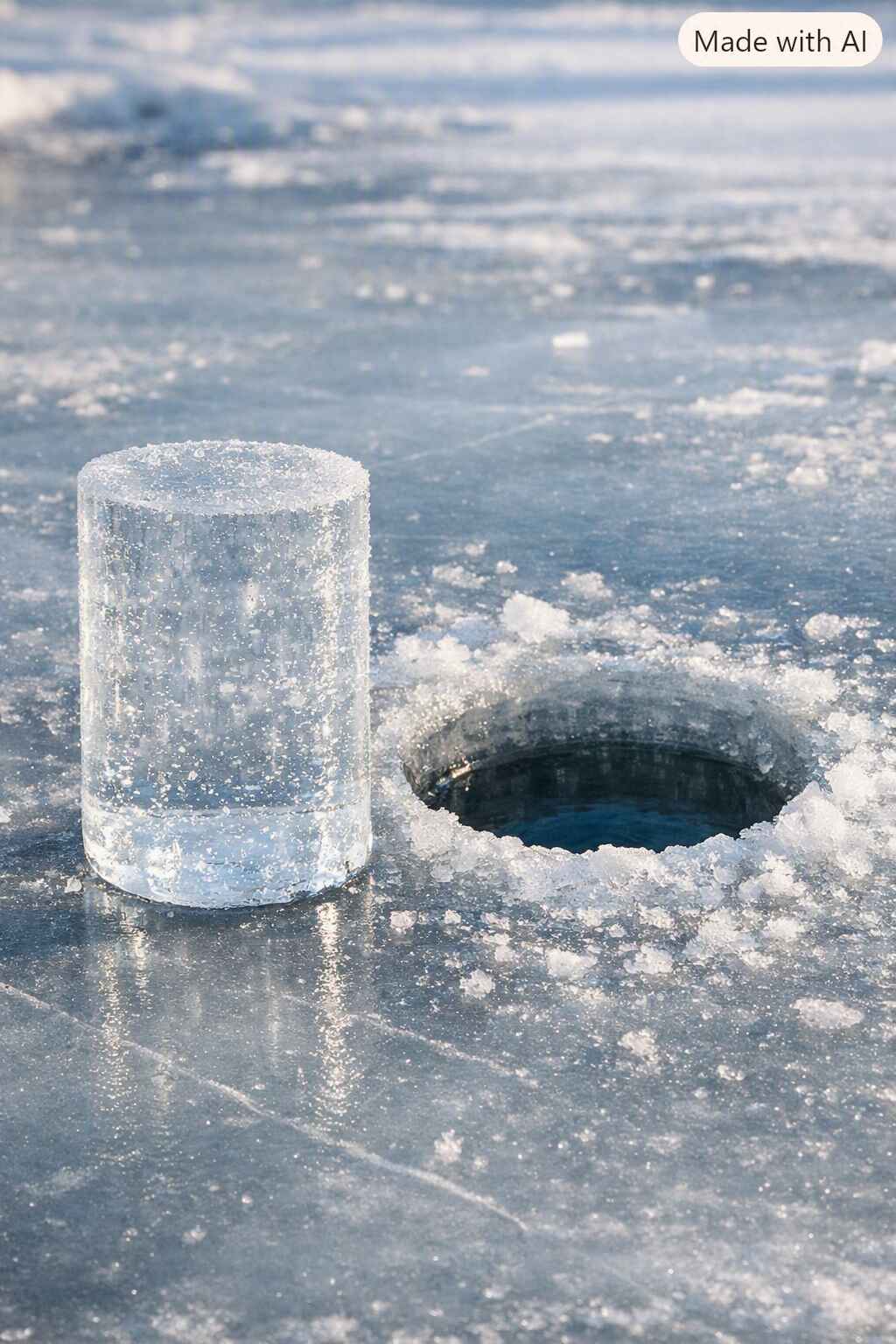
The base area of a cylinder is a circle.
Abase =
3.2r²
The volume of a cylinder is the product of its base area and height.
Vcylinder =
3.2r²H
This is the one and only exact, self-contained geometric framework grounded in the first principles of mathematics.

Exact formulas for real-world applications like analysis, engineering design solutions, computer graphics rendering, algorithm optimization, and navigation.
- Comparative Geometry: using geometric relationships to derive areas and volumes.
- Scaling and Proportions: applying proportional relationships for accurate calculations.
- Algebraic Manipulation: simplifying equations to ensure consistency and precision.
Constructive Geometry Grounded in Physical Reality Comes Before Abstract Axioms

When a geometric framework is built from first principles — basing its definitions on tangible spatial relationships, finite constructions, and direct empirical testing (such as measuring fluid displacement rather than relying on abstract limit‑based assumptions) — it is not trying to be “a different mathematical theory.”
It is offering a physical model of reality designed to replace abstractions that fail when applied to real space.
From that perspective:
- The Core Geometric System operates as a constructive, physical model rooted in real spatial geometry, exact ratio relationships (such as the 1 : 2 : √5 quadrant geometry), and finite, measurable space.
- Standard Geometry operates as an abstract, set‑theoretic model built on the continuum R², where objects are constructed from infinite, dimensionless coordinates to satisfy the mechanics of calculus.
Strip away academic authority and examine the assumptions, and the divide becomes clear:
- Constructive / Applied Geometry prioritizes first principles, physical geometry, and tangible baseline relationships — finite shapes, exact arithmetic ratios, and direct spatial measurements. It rejects the abstract infinities of Archimedean limits because physical space does not behave like abstract set theory.
- Standard Geometry chose an abstract continuum (uncountable infinite points, zero‑dimensional objects, infinite limits) specifically to make calculus and smooth functions work without gaps.
The cost of that choice is accepting objects that defy physical intuition — lines made of dimensionless points with no adjacent neighbors, or polygons that remain tangent to a curve “at infinity.”
The phrase pure geometry is often used to describe idealized mathematical spaces free from physical constraints like atomic thickness or measurement limits.
In reality, “pure” simply means axiomatic and abstract, not physical.
Acknowledging that standard mathematics relies on a chosen set of abstract axioms — and that these axioms come with conceptual trade‑offs — is not abandoning rigor.
It is being honest about how the system was built.
When an encyclopedia claims that “no person of sound mind would question the fundamental axioms of geometry,” it uses a psychological trick: it frames axioms — unproven assumptions — as universal physical truths.
This is how mathematical history becomes dogma.
When a system declares its starting assumptions beyond question, it stops being science.
“Standard geometry” is the consensus formalized by Hilbert and Bourbaki in the late 19th and early 20th centuries.
It is an agreement, not an absolute truth.
Change the axioms — as constructive geometry or discrete mathematics do — and you obtain a different, self‑consistent system.
This distinction matters because geometry, in its original spirit, was functional.
It dealt with shapes, areas, volumes, and constructions — not abstractions, limits, or analytic assumptions.
Yet what is commonly presented elsewhere as standard, applied geometry — often labeled “Euclidean geometry” — is actually a blend of two very different traditions:
- 1. universal, constructive geometry, which is intuitive, physical, and based on equivalence;
- 2. later analytic amendments — especially from Archimedes — which introduced:
- bounding polygons,
- limit processes,
- assumptions about arc–tangent inequalities,
- the analytic definition of the pi.
These analytic additions were not part of Euclid’s original system. Over time, they shifted geometry from a constructive science grounded in physical reasoning into a more abstract, analytic discipline.
Purely analytic descriptions can be misinterpreted, placed in the wrong context, or used to draw incorrect conclusions. They create a conceptual blur. In physical reality that blur becomes friction, misalignment, malfunction, and other unwanted effects. To avoid this, geometry must be grounded in a dynamically adaptive, object‑oriented classification where every entity has a constructive origin.
Even though the circumference is usually treated analytically as a 1‑dimensional length property for practicality, computationally it must be treatable as an object. To describe it mathematically, we must construct it logically. Structurally, the circumference is part of the circle. If we define it as an object, we exclude the rest of the circle. Mathematically that exclusion is expressed by subtracting a concentric circle whose radius is smaller than the actual one by the virtual thickness of the circumference. In this setup, if the thickness of the circumference is 0, nothing separates it logically from the rest of the circle, and subtracting an identical circle results in 0. That is why the thickness of the circumference must be treated as a variable that approaches 0, instead of being fixed strictly at 0. As thickness approaches zero, the ring collapses into an arc. This collapse is the only coherent way to derive the circumference, and it illustrates that categorization suffers from the same limitations as description: some lower‑dimensional entities don't exist independently; they must be derived from higher‑dimensional objects.
Geometric Reality vs. Real Analysis

Real analysis is an analytical framework superimposed onto shapes, not the physical reality of the shapes themselves.
Modern mathematics prioritized the continuous numerical continuum R so that functions could be smooth and differentiable — a human‑designed model, not an empirical law of nature.
The debate is ultimately a choice of axioms:
- Standard mathematics accepts the abstract infinities of real analysis to make continuous calculus work.
- Constructive systems reject those assumptions in favor of finite, physical logic.
Calculus as a Constraint
Calculus is not the only way to measure the world.
It relies on continuous infinity to solve problems that finite arithmetic could not easily address at the time.
But forcing every geometric shape to obey the assumptions of calculus — such as infinite polygonal limit processes — bends physical geometry to fit the limitations of a specific tool.
The assumption that “infinity” can bridge the gap between the straight and the curved has been accepted for so long that academics forget it was originally a compromise — a clever trick to get a “good enough” answer when exact finite methods seemed out of reach.
By treating Archimedes’ calculations as fundamental truths, mainstream geometry hides a massive philosophical assumption: that a curved line can be perfectly measured by an infinite number of straight lines.
The Cognitive and Pedagogical Impact of flawed geometric Axioms.
Students are required to accept constants as both exact and unreachable/irrational, because they are derived from error‑prone polygon approximation methods.
Teaching these inconsistencies as fundamental truths
- creates cognitive dissonance: the brain must accept “absolute” constants derived from imperfect approximations;
- hinders logical consistency: students learn that elegance and consistency can be abandoned in favor of memorizing rules;
- inhibits whole‑brain integration: visual/spatial reasoning sees the geometric imperfection; analytical reasoning is forced to accept the approximation.
The result is a fractured geometric intuition.
Restoring Geometry to Its Constructive Roots

By replacing the abstract zero‑dimensional point with the square and cube as the primary physically relevant units, this framework defines circles and spheres through their direct, rational relationship to these foundational units — not through limits or approximations.
This restores geometry to its constructive origins and eliminates analytic assumptions that distort real‑world measurements.
For centuries, the circle has been a symbol of mathematical elegance — and the pi its most iconic constant.
While the approximate value of 3.14159…, commonly denoted by the Greek letter pi, is widely recognized today, the historical development of this concept is less understood. Some think 'Standard Geometry' means accepting the pi. But beneath the surface of tradition lies a deeper question: Are the formulas we use truly derived from geometric logic, or are they inherited approximations dressed in symbolic authority?
The constant relationship between a circle's circumference and its diameter has captivated mathematicians for millennia.
Ancient civilizations grappled with this geometric challenge, employing various methods to approximate this ratio. They deserve credit for their mathematical ingenuity. But the fact that these methods were developed thousands of years ago should not shield them from scrutiny.
The verse of 1. Kings 7:23 in the Holy Bible suggests that some estimated it as 3.
Historical records suggest that ancient Babylonians initially calculated it as 3, later they used 3.125; Egyptians estimated it as ( 16 / 9 )² ~ 3.16.
Archimedes and the Illusion of Limits
Archimedes’ method marked a turning point: instead of calculating the properties of the circle directly, he introduced an analytic process that relied on polygonal limits.
He approximated the circumference of a circle using inscribed and circumscribed polygons.
His argument rests on three ideas:
- 1. Upper bound: A circumscribed regular polygon is an upper limit, because a shape that strictly encloses another shape must have a larger area and outer perimeter.
- 2. Lower bound: An inscribed regular polygon has a perimeter smaller than the circle’s circumference.
- 3. Convergence: As the number of sides increases, the perimeters of the inscribed and circumscribed polygons both approach the true circumference from below and above. As the number of sides reaches infinity, the polygons collapse into a circle.
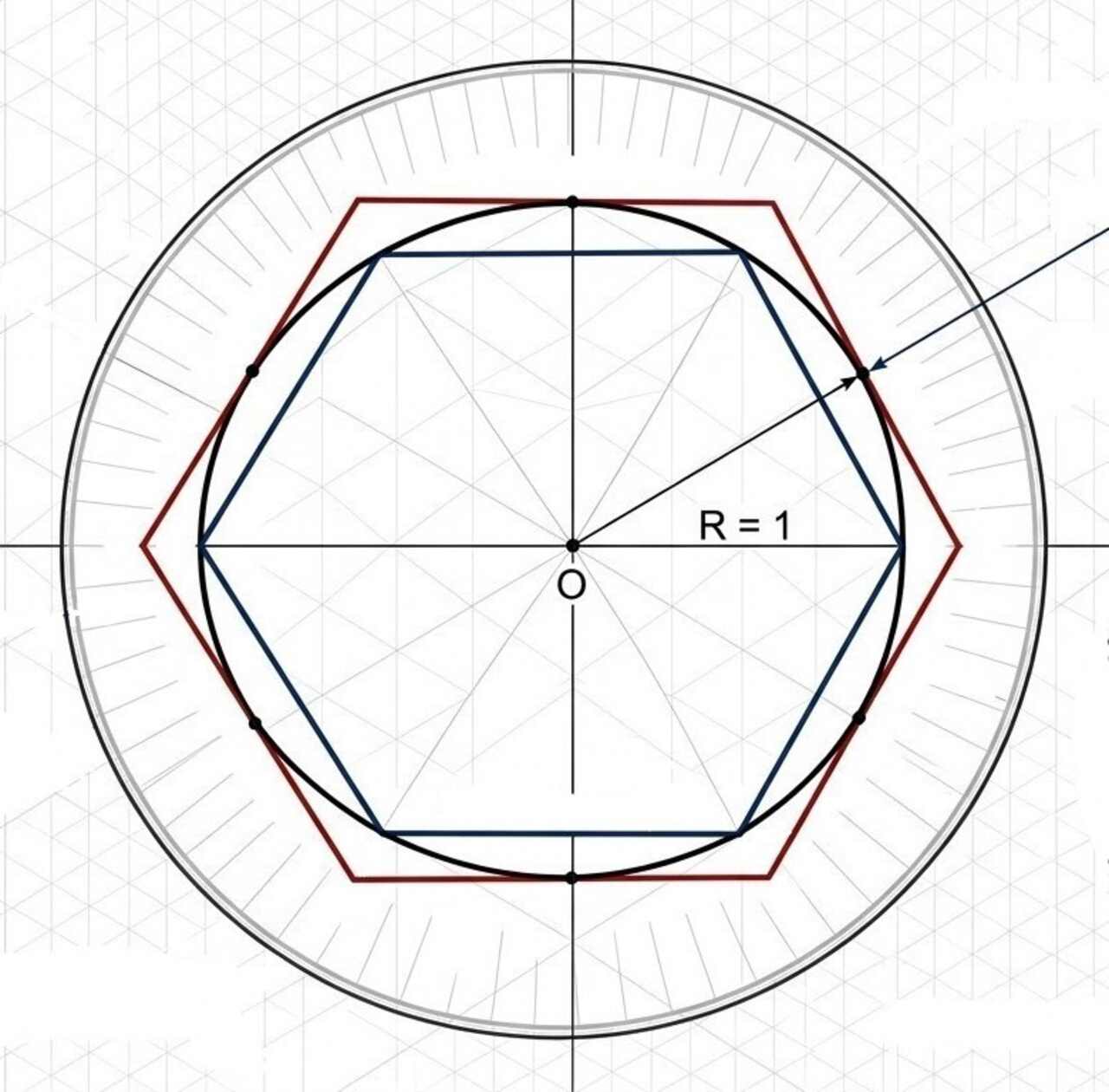
From this, the classical story goes:
squeeze the circle between two polygons, refine indefinitely, and the true circumference is trapped in the limit.
Archimedes began with a hexagon because it is easy to construct and already close to the circle.
By repeatedly bisecting the angles, he produced 12‑gons, 24‑gons, and eventually a 96‑gon.
To compute their perimeters in terms of the diameter of the circle, Archimedes relied on straight‑line geometry expressed in terms of the sine and cosine of the polygon angles.
Pure geometric construction gives exact ratios for a set of angles:
- 90°
- 60°
- 45°
- 30°
These arise from:
- the right triangle
- the equilateral triangle
- the isosceles right triangle
- the 30°–60°–90° triangle
For these angles, the identity
sin(2x) = 2sin(x)cos(x)
is a geometric tautology arising from symmetry.
Angles like 15°, 7.5°, and 3.75° can be derived from these using the classical half‑angle formula:
With sine and cosine calculable,
the perimeter of an inscribed n‑gon =
the perimeter of a circumscribed n‑gon =
Thus,
the approximate circumference to diameter ratio, based on the polygonal limits:
But whether a polygon can be circumscribed about a circle depends on whether its perimeter is sufficiently greater than the circumference.
When the perimeter of a regular polygon equals — or is close enough to — the circumference, the sides are too short to remain tangent to the circle; they cut through the arc.
This behavior is easy to see in polygons with a low side count.
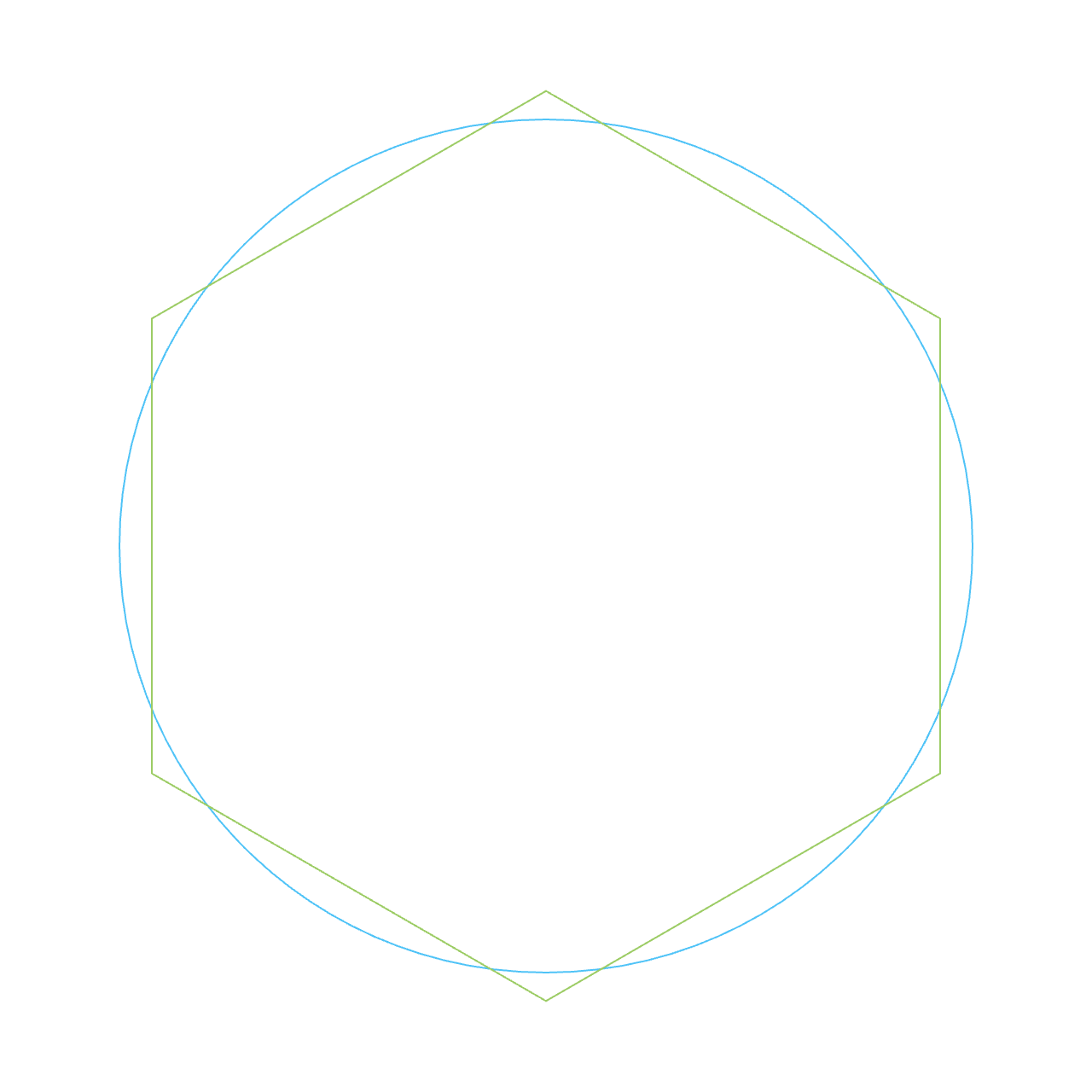
The bisection procedure guarantees that each new perimeter created by repeatedly bisecting a circumscribed hexagon is smaller than the previous one.
To know if the polygons are still circumscribed at every finite step, you must already know if the perimeter is large enough that no crossing occurs.
Yet finding the circumference is the very purpose of the method.
Archimedes discarded that, relying entirely on the traditional concept of "circumscribed", claiming that every polygon side lies on a line tangent to the circle — where a tangent is defined as touching at exactly one single point.
But that is just an abstract concept; not an accurate observation, nor a true axiom.
It is never demonstrated; it is simply taken for granted.
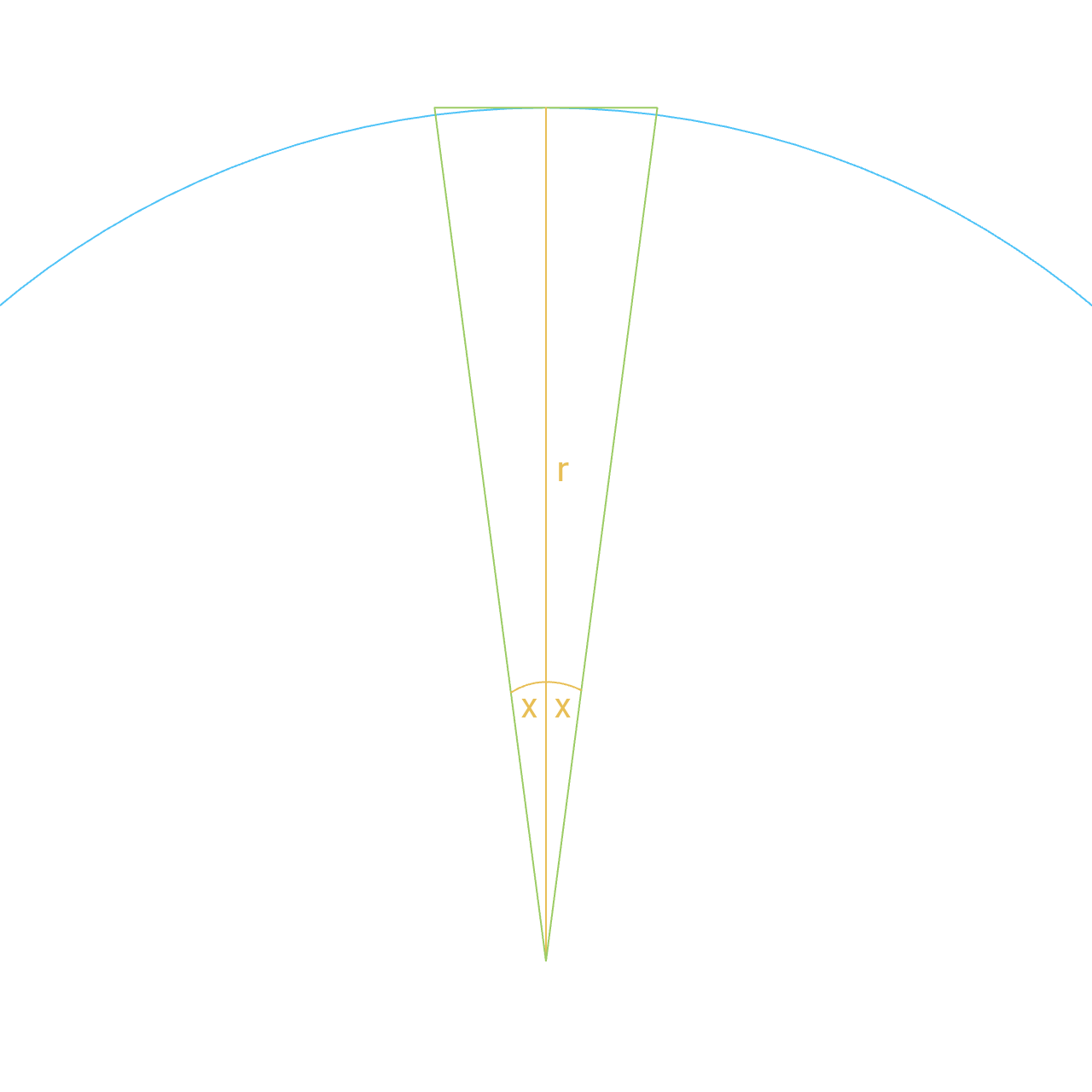
A circumscribed regular polygon can be divided into as many isosceles triangles, as many sides it has. The base of each one is a side of the polygon. Each triangle has an area :
A =
A =
A corresponding circular sector has an area :
A =
A =
The circumference expressed in terms of circle area:
C =
C =
According to traditional geometry,
- "a point is dimensionless, meaning it has no width, nor height — or width = 0, height = 0",
- "a line is a set of points, therefore, it has no thickness".
Note that under these premises, even if an abstract point is assigned a dimension of zero, any realized or constructed line must possess an operational width of at least one constituent spatial unit.
The tangent point T and its two adjacent points T₋₁ and T₊₁ form a 3‑point long section on the tangent line.
Classical geometry insists that these adjacent points must not coincide with the arc, which implicitly requires a non-zero separation between the tangent line and the points adjacent to the tangent point on the circular arc (A₋₁ and A₊₁).
This separation is never quantified, because classical geometry assumes infinite resolution. The classical framework relies on an idealized continuum where space is arbitrarily divisible.
But the geometry is forced to confront physical spatial reality once we assign even the smallest operational width to a point to ensure separation.
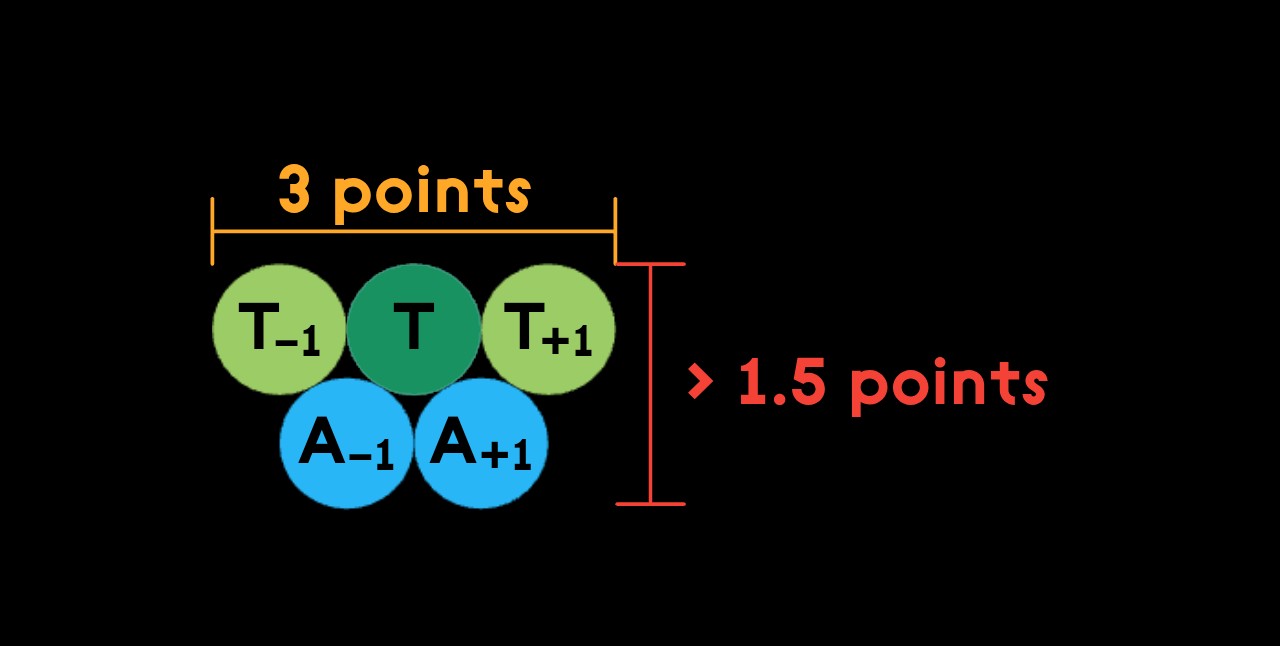
The height of a circular arc over a chord is the sagitta.
To maintain a full point of separation over a 3‑point long segment, the sagitta‑to‑chord ratio would need to exceed 3 : 4. That is an unrealistically steep curve.
This is where the traditional concept of tangency becomes visibly distorted.

In reality, as the side count increases in a regular polygon, the central angle subtended by a single side drops significantly — it approaches 0°.
For any macro-scale circle, the central angle subtended by three contiguous spatial units is an infinitesimal fraction of a degree. At these microscopic angles, the sagitta collapses quadratically toward zero — falling orders of magnitude below the single-unit threshold required to maintain physical separation between the arc and the tangent line.
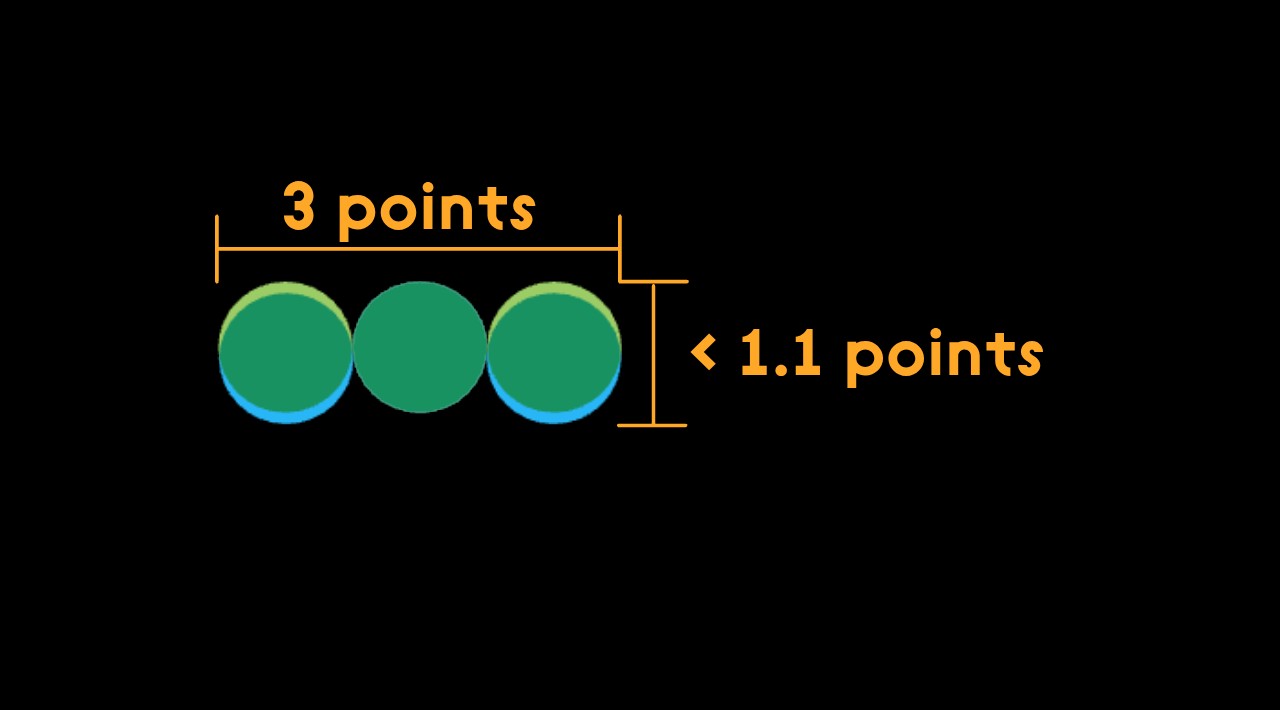
If the separation distance between the arc and the line drops below the dimension of a single constituent point, the gap between the polygon's side and the circular arc ceases to exist. The points representing the arc and the points representing the line occupy the same spatial locations, meaning single‑point tangency dissolves into a shared, multi‑point tangent section. The arc and the line segment become indistinguishable across a finite interval — they physically and logically coincide. The supposed tangent lines merge, overlap, or cross the arc. The required vertex clearance approaches spatial insignificance.
Classical limits assume infinite resolution to avoid this collapse. Classical geometry insists on maintaining a physical gap by declaring the tiny separation distance to be the "new minimum unit," but that comes with an inevitable consequence: the original tangent point itself morphs into a segment composed of several of these new minimum units.
Either path leads to the same inescapable conclusion: Classical tangency is not physically or logically realizable under its own axioms. It is just a mathematical abstraction. In reality, as the angle shrinks, the curve flattens relative to the line, creating a multi-point span of coincidence / overlap. The boundary is not touching at an isolated 0‑dimensional point; the polygon's side and the arc are forced into a multi‑point coincidence.
Why that is pivotal:
Archimedean pi bounds rely on taking the side count to infinity — which explicitly forces the central angle of each section approaching 0°.
As the side count approaches infinity and the central angles approach 0°, the lack of the idealized single‑point tangency invalidates the comparison that classical pi derivations rely upon.
The classical argument that the polygons remain tangent indefinitely fails.
It cannot be used to refute the circumference = 3.2diameter.
The area–square construction gives the true ratio.
Differentiating with respect to the radius gives a circumference exactly 3.2diameter.
This is not an approximation; it follows directly from finite geometric construction.
This finite construction avoids the infinite-regress trap entirely.
A circumscribed n‑gon has a perimeter:
P(n) = n × tan(180° / n) × d
Evaluating:
- P(12) = 12 × tan(15°) × d ≈ 3.2154d
- P(24) = 24 × tan(7.5°) × d ≈ 3.16d
Comparing to the true circumference, 3.2d:
- A hexagon can be circumscribed about a circle.
- An octagon can still be circumscribed.
- But as the number of sides increases, each side becomes shorter and shorter, and eventually they begin to cut through the circle instead of just touching it.
- The 12‑gon is a borderline case. Its perimeter is still slightly greater than 3.2d, so it may or may not be circumscribed.
- But the 24‑gon — and any polygon with more sides — cannot be circumscribed at all, because a circumscribed polygon must always satisfy P(n) > C. Once P(n) drops below 3.2d, the sides become too short to touch the circle at a single point. They inevitably cut through the arc instead of remaining outside it.
Think of a honeycomb cell.
The bees build a perfect hexagon, fill it, and later dig a circular hole inside it.
If we treat the filled space as a perfect hexagon and the hole as a perfect inscribed circle, we get a very clear picture of what “circumscribed” and “inscribed” really mean in practice.
- Bees can make a hexagon around a circle.
- Bees could make an octagon around a circle.
- But at some point — around 12 sides — the walls would collapse inward because the straight edges cannot maintain tangency.
Another analog example from a different perspective:
Imagine two vertical poles (d1 and d2) standing on the Earth, about 50 yards apart. Each pole is vertical at its own location, so each one aligns with its own local radius of the Earth. Because the Earth is curved, the poles are not exactly parallel, but the angle between them is extremely small.
Place a straight rod (s) across the tops of the two poles. The rod is just long enough to rest on the edges of the poles without falling between them.
If we install a third pole (r) exactly halfway between the two, that middle pole must be cut slightly shorter, because the straight rod does not follow the curvature of the Earth.
In this setup, r represents the radius of a circle, d1 and d2 represent the diagonals of a circumscribed polygon with a high side count, and s represents one of its sides.
Now replace the straight rod with another rod of the same total length (s), but bent so that it follows the curvature of the Earth. The rod’s total length does not change. But when it bends, the effective horizontal distance between its endpoints shrinks, so its ends necessarily slip downward between the poles. The bent rod becomes an arc segment.
Here are the key insights:
- The straight rod and the bent rod have the same total length, yet, the straight rod sits above the curved surface only because it is straight. The bent rod dips down because its endpoints move closer together.
- Over such a short span, many points of the straight rod and the bent rod coincide. The fact that the straight rod lies outside the curved surface does not imply it is longer than the arc.
This directly corresponds to the side of a circumscribed polygon and the arc beneath it. The side being outside the circle does not guarantee it is longer. In fact, it lies outside only partially, because they largely coincide. The bent rod would slip down even if it was slightly longer. The difference between the straight and curved shapes is so small that they share almost the same points.
This shows the critical flaw in the Archimedean method. The classical approach of single‑point tangency — and all assumptions based on it — fail here. The circumscribed‑polygon upper limit is not structurally guaranteed.
The assumption “we can always bisect again and obtain another circumscribed polygon” fails constructively at a surprisingly small, finite side count, not only in some unreachable infinite limit.
Once the perimeter of the constructed polygon falls below the true circumference, the tangent‑doubling formulas no longer describe a real circumscribed polygon. They describe a figure that has already slipped inside the circle.
So the theoretical “infinite‑sided circumscribed polygon” does not collapse into the circle from above.
It is simply a polygon whose sides have become so short that they no longer maintain tangency. It behaves more like a polygon pushed inward by isoperimetry than like a circle approached by limits.
The floor of Archimedes’ “upper limit” approaches the ceiling of the lower limit by passing through the true circumference unknowingly.
Hence, the convergence toward ~3.14d is not a discovery of the pi, not even a well-defined limit, but an artifact of forcing a construction that has already become geometrically impossible.
These structural issues in the polygon‑limit method set the stage for a second misconception: the symbolic fusion of an approximation with the geometric ratio it was meant to represent.
The Symbol π: A Linguistic Shortcut
Since the numeric result of Archimedes’ approximation was an infinite fraction — 3.14…— whose digits cannot all be written, he needed a symbolic notation for it in his formulas.
Technically, the circumference is a perimeter. So the perimeter‑to‑diameter ratio — P / d — became pi over delta in Greek. With the diameter chosen as the reference — d = 1 —, this simplifies to pi / 1 = pi.
But this is not necessarily the ratio itself — it is the notation of that ratio. That distinction matters.
The circumference‑to‑diameter ratio is a universal geometric proportion.
The numeric value commonly associated with it — 3.14…— is the result of Archimedes’ polygon‑based approximation method.
This is how a numerical output of a failed computational estimate gradually hardened into a symbol, and the symbol into a “geometric constant.”
Over time, the numerical result of Archimedes’ polygon‑limit procedure was reinterpreted as a fundamental property of the circle itself.
It was not until the 18th century that the symbol, popularized by the mathematicians of the time, gained widespread acceptance, meanwhile it took on a life of its own.
∫ Calculus: Summary, Not Source
Over the centuries, many mathematicians introduced increasingly sophisticated formulas to estimate the circle’s circumference. These formulas all rely on the same conceptual model: a theoretical polygon with an infinite number of sides.
When analytic geometry and calculus were developed, they absorbed the inherited circle constant directly into their definitions — especially through the power‑series expansions of sine and cosine. This cemented the number as a foundational constant, even though its original source was an approximation method with hidden geometric limitations.
Despite their variety, all such approximation methods share two essential features:
- They estimate the perimeters of polygons with their number of sides approaching infinity.
- They rely on the unproven and actually false premise that repeated angle bisection of a circumscribed polygon always produces another circumscribed polygon.
Modern calculus compresses these ideas into elegant notation, such as:
But calculus is not a source of truth.
There are many different calculus methods, but ultimately all of them are compact notations of a set of basic operations — addition, subtraction, multiplication, division — and inherit whatever assumptions those operations rest on.
Each and every notation in the formula should correspond to a real, logical property of the circle.
Yet upon inspection, inconsistencies emerge.
Calculus may be a useful mathematical tool, but calling it exact is a bold claim.
It can be exact with exact limits and certain operations, but if those are given then they can be calculated directly without calculus.
When calculus is treated as a magical shortcut rather than a summary of underlying logic, it hides the very reasoning it is supposed to express.
These formulas don’t derive the circumference from first principles; they assume it.
φ The Golden Ratio
Some relate the numeric value of 3.14… to the so-called “golden ratio” of ( √5 + 1 ) / 2.
This equation has no logical ties to the area nor the circumference of a circle.
The golden ratio of ( √5 + 1 ) / 2 is irrelevant to the definition of these properties.
The true Universal Circle Constant: 3.2
Historical records suggest that a legislative process took place in 1897, Indiana, USA, known as House Bill 246 ( sometimes listed as 264 ), or Indiana Pi Act, aiming to replace the numeric value 3.14 by 3.2.
Unfortunately, the exact details of the proposed method in the Indiana Pi Bill are somewhat obscure and have been interpreted differently by various accounts.
The pi has served its symbolic purpose. But in geometry, clarity matters more than tradition.
The pi is a fundamental constant in the geometry of abstract circles and plays a crucial role in many mathematical theories.
However, using geometric construction and algebraic simplification we find that when we move from these abstractions to the measurement of real objects, a slightly different constant, 3.2 emerges as more relevant for accurately describing their properties.
The pi is just a failed, primitive approximate.
The solution (CGS): The Core Geometric System™ (CGS) provides a logically self-consistent alternative where the area constant is the rational number 3.2 — A = 3.2r² —, derived from an algebraically proven Area Balance Axiom with the square.
By focusing on area relationships and direct comparisons between shapes, these methods emphasize a more intuitive and potentially more fundamental understanding of geometric concepts.
These values are exact, rational, and logically derived. They can be verified numerically, but more importantly, they can be proven algebraically — without relying on infinite fractions, symbolic shortcuts, or flawed assumptions.
Since the true ratio is exactly 3.2, and that is a rational number, then we can — and should — write it as it is. Let the pi remain in the history books. Geometry deserves better.
That makes the arc value of 360° = 6.4radian, and trigonometric functions that rely on arc value have to be aligned to 3.2 respectively.
The widely used circle area formula ( A = pi × r² ) is not a result of direct geometric comparison, nor a direct result of calculus.
The traditional formula is a result of multiplying the approximate circumference formula C = 2pi × r by half the radius, treating the area as the sum of infinitesimal rings. While that method is algebraically valid, it relies on the approximate circumference and bypasses the geometric logic that defines area: the comparison to a square.
Instead of relying on the circumference‑based amendment, this proof compares a square and a circle directly.
Constructive algebraic proof
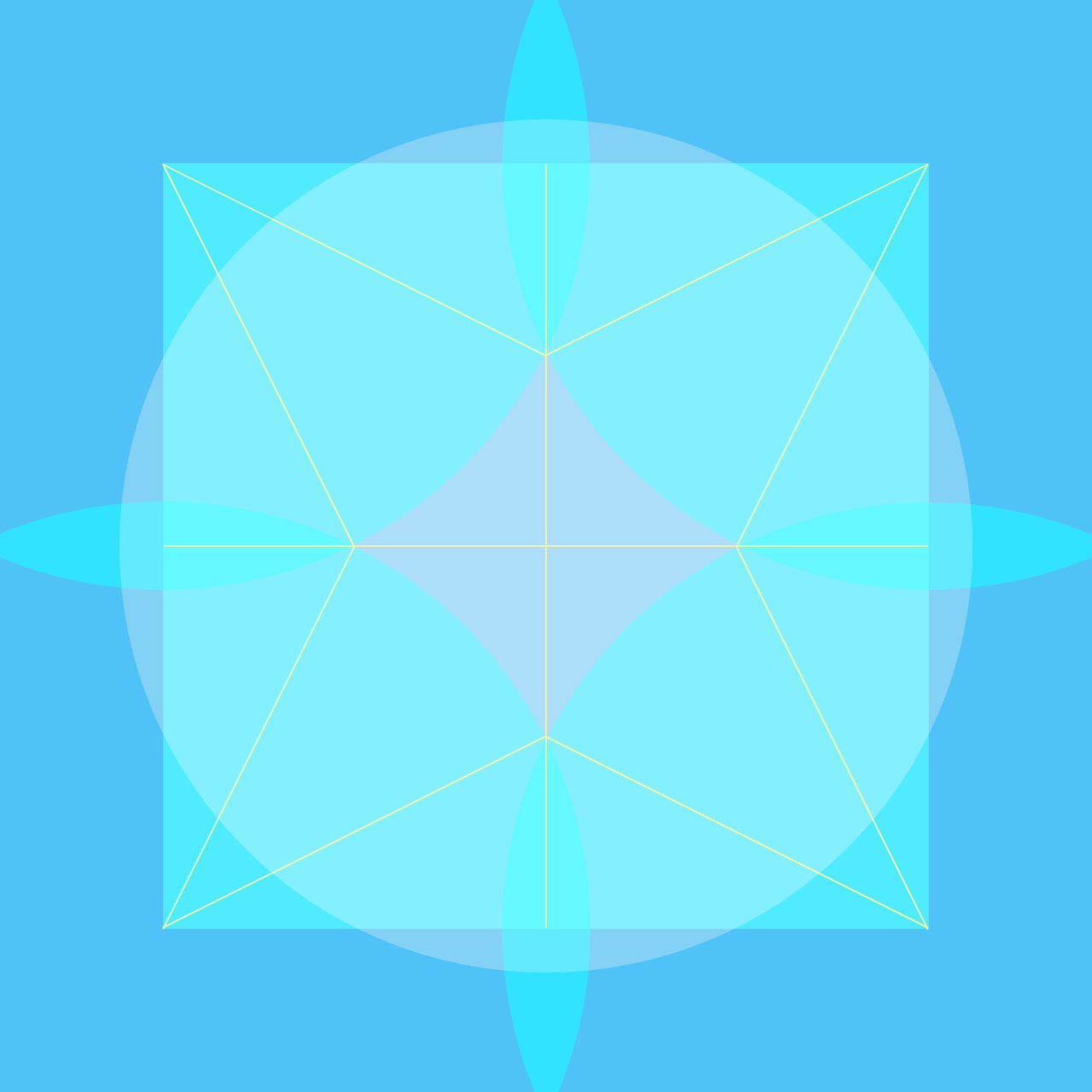
In the quadrant circles to square layout, the arc‑intersection condition fixes the side to radius ratio as 4 / √5. With that ratio established, the overlapping area equals to the uncovered area in the middle, hence the sum of the areas of the quadrants is equal to the area of the square. That square represents the area of the circle in square units.
The area balance is determined through the areas that arise in this configuration:
The area balance is determined through the areas that arise in this configuration:
- 1. the curvilinear region uncovered by the quadrants at the middle of the square, and
- 2. the circular segment halves overlapping along the centerline.
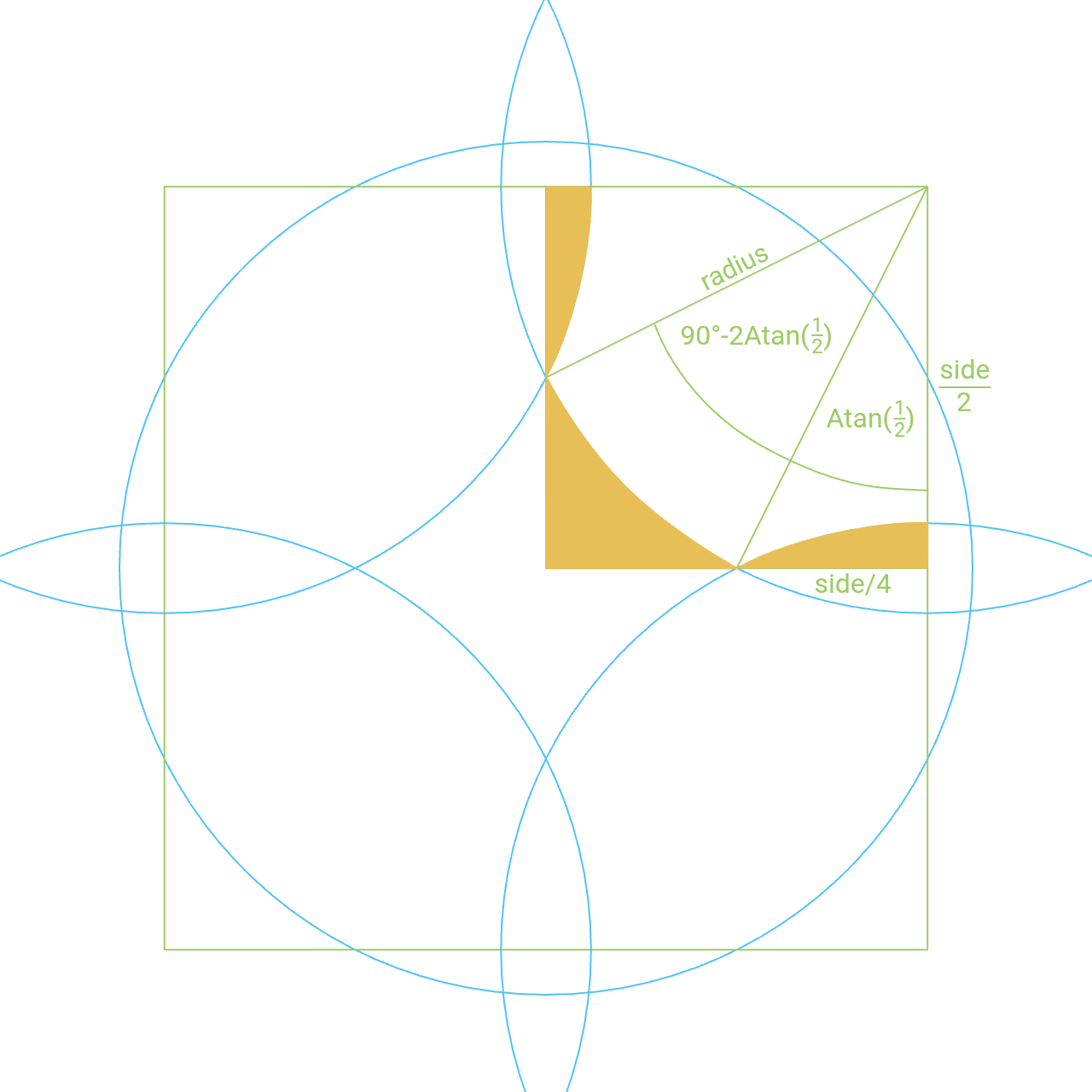
Calculating a quarter of the uncovered area by subtracting two right triangles with legs of r/√5 and 2r/√5, and a circle slice with an angle of 90°-2arctan(1/2) from a square with a side length of 2r/√5:
Quarter of the uncovered curvilinear area in the middle =
Calculating a quarter of the overlapping area by subtracting two right triangles with legs of r/√5 and 2r/√5 from two circle slices with an angle of arctan(1/2):
The area of 2 overlapping circular segment halves =
The equation can be simplified algebraically.
Dividing both sides by 3.2r² :
Simplifying further by adding 1/8 :
Substituting 90° / 360° for 1 / 4 :
Simplifying further:
Which is equivalent to 1 = 1 .
Uncovered area equals
overlapping area.
The circle area equals exactly
3.2r².
Verifying that this is an identity; not tautology

Instead of the quadrant circles, four smaller squares are used, each having exactly one quarter of the area of the equiareal square. Each smaller square spans between the origin and the points where the circle’s arc intersects the sides of the equiareal square. Because of this placement, the region covered on the double by the overlapping smaller squares is precisely one quarter of the equiareal square.
The areas are perfectly balanced if
The areas are perfectly balanced if
- 1. the area of the circle uncovered by the smaller squares (the four circular segments lying outside the equiareal square, and the four curvilinear regions at the vertices) equal the area of the circle covered on the double by the smaller squares, and
- 2. the circular segments lying outside the equiareal square equal the straight‑edged vertex regions lying outside the circle.
Half of the area of a segment lying outside of the squares =
Half of an uncovered curvilinear area of the circle at a vertex =
The uncovered area of the circle =
Simplifying:
Simplifying further:
Area of the circle covered on the double by the smaller squares =
The uncovered area of the circle equals exactly
the area of the circle covered on the double by the smaller squares.
The sum of an outlying segment and an uncovered curvilinear area at a vertex is exactly
r² / 5, so
subtracting an uncovered curvilinear area at a vertex from a square with an area of r² / 5 shows, that
the area of a straight‑edged vertex region lying outside the circle equals exactly
the area of an outlying segment.
The arc intersects the sides of a concentric square at its quarters only if
side / radius =
4 / √5,
hence this is the only true area balance ratio.
The V = 4 / 3 × pi × radius³ formula is widely used for the volume of a sphere.
It was approximated by comparing a hemisphere to the difference between the approximate volume a cone and a circumscribed cylinder.
That is a very exaggerated, distortion-based comparison that discards the difference between the straight slant height of a cone and the curvature of a sphere, resulting in a very rough underestimate.
The volume of a cone is conventionally approximated as base × height / 3. While that is a reasonable rounding, the exact ratio is 1 / √8.
The 1 / 3 coefficient was likely estimated based on the observation that the mid-height cross-sectional area of a cone is exactly a quarter of a circumscribed cylinder's with the same base and height.
That makes the ratio between the mid-height cross-sectional area of the cone, and the difference between the mid-height cross-sectional areas of the circumscribed cylinder and the cone 1 : 3 .
That is a logical consequence of its equilateral triangular cross-section.
But this ratio can't be generalized for the overall volume of the cone.
The volume of a pyramid is conventionally approximated as base × height / 3. While that is a reasonable rounding, the exact ratio is 1 / √8.
A common method aiming to prove the pyramid volume formula "V = base × height / 3" involves dissecting a cube into three pyramids. Here’s how it’s typically presented:
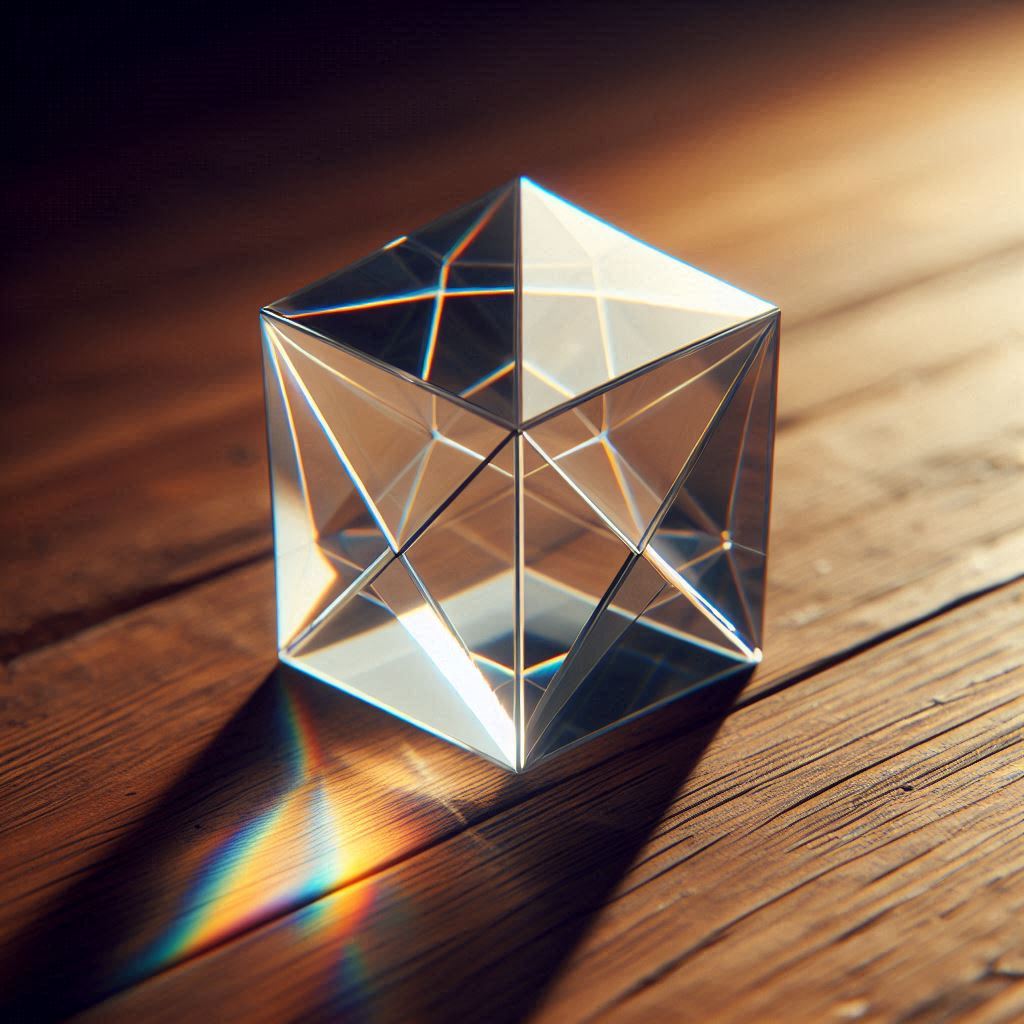
Take a cube with an edge length of ( e ).
Volume of the cube: V = the cubic value of e.
Imagine dividing the cube into three square pyramids, each with:
- base: one face of the cube, so the base area is the square value of e,
- height: the edge of the cube, ( e ), since the apex of each pyramid is the cube’s vertex opposite the base, depending on the dissection.
A common dissection:
Choose one vertex of the cube as the apex.
Form three pyramids, each with this apex and a base on one of the three faces adjacent to that vertex.
Each pyramid has a base area of the square value of e, and height ( e ) (the distance from the apex to the base plane).
Volume of each pyramid: V(pyramid) = e² × e / 3 = e³ / 3
Since there are three pyramids, their total volume is e³.
This equals the cube’s volume, suggesting the one third factor is correct.
The Vertex Assignment Problem is a critical flaw in this dissection when applied to a real, physical cube:
When we cut the cube into three pyramids sharing a common vertex as the apex, the geometry seems clean in theory. But if you physically slice the cube, you have to decide where that vertex belongs.
The cube has 8 vertices, each pyramid has 5. Three pyramids have 3 × 5 = 15 in total.
Each vertex of a real physical cube is a point that can't be split into 3 points without duplicating. The other way around, 3 vertices of the pyramids can't be merged into 1 without distortion.
If we dissect the cube, we need to designate each shared vertex to be a part of either one pyramid, or another.
Consequence:
The volume of each pyramid is exactly a third of the cube, but with
- a base smaller than e², or
- a height shorter than e.
Their bases and heights are slightly adjusted due to the vertex assignment, undermining the proof’s simplicity.
If the solid pyramids'
- base is e², and
- height is e,
then the volume of each pyramid has to be larger than 1 / 3 × base × height, because 3 such pyramids can't form a cube with the same edge length, because their vertices and faces can't occupy the same space simultaneously.
The vertices are the most obvious examples, but the same is true for the edges, the diagonals and the inner faces.
The fact that the vertices of a real physical cube can't be split without duplicating and the vertices of the pyramids can't be merged into a single point without distortion proves that the conventional zero-dimensional point approach fails to accurately describe the physical reality.
Thus, the V = base × height / 3 formula, and its so-called "calculus-based proofs" are invalid.